

A combination square is one of those tools that quietly earns its place on every workbench. It marks 45- and 90-degree angles with precision, checks surfaces for flatness, transfers measurements, and even doubles as a depth gauge. Whether you are framing a deck, fitting cabinet doors, or scribing trim, accurate layout work starts here. We researched and analyzed dozens of models across price tiers so you can buy with confidence instead of guessing on a jobsite.
The products below range from budget-friendly picks that punch above their weight to professional-grade squares from brands like Starrett, Milwaukee, Klein Tools, and iGaging. Pairing a reliable combination square with a quality tape measure covers the two most fundamental layout tasks in any workshop. Read on for our full breakdown of what to look for and which square belongs in your toolbox.
Top Combination Squares

Pros
- Stainless steel blade won't rust or stain, even with moisture exposure
- Clear, precision-etched markings stay visible and accurate after extended use
- Compact 12-inch size makes it ideal for detailed work and tight spaces
- Solid cast zinc body feels substantial and reliable in hand
- Versatile tool handles multiple marking and measuring tasks efficiently
Cons
- Limited to 12 inches, which may feel small for larger layout projects or framing work
- No reviews available yet, so long-term durability feedback from homeowners is not yet established
The IRWIN 12" Combination Square delivers the precision and durability that both weekend DIYers and seasoned carpenters expect from this essential layout tool. The stainless steel blade resists rust and corrosion, making it reliable whether you're working in a dry garage or a damp basement. The black precision-etched scales remain sharp and legible through years of use, ensuring your measurements stay accurate project after project.
This tool excels at marking both 90-degree and 45-degree angles, making it invaluable for everything from framing layouts to trim work and furniture building. The durable cast zinc body feels solid in your hand and can handle the inevitable drops and impacts of real-world jobsite conditions. Beyond marking, the square functions as a gauge for transferring measurements, which streamlines your workflow and reduces setup time.
At 12 inches, this combination square strikes a practical balance between portability and usability. It's compact enough to fit in a tool belt or toss in a project bag, yet long enough to handle most household and shop tasks. If you're building a basic tool collection or upgrading from a worn-out square, the IRWIN combination square offers solid value and the reliability that makes it a workshop staple.
| Feature | Details |
|---|---|
| Brand | IRWIN |
| Length | 12 inches |
| Blade Material | Stainless Steel |
| Body Material | Cast Zinc |
| Angle Capability | 45-degree and 90-degree marking |
| Scale Type | Black precision-etched |
| Corrosion Resistance | Rust-proof design |
| Model Number | 1794469 |
90-Degree Marking: Place the blade flush against your workpiece edge with the head square against the adjacent edge. Slide the head along to mark a perfect perpendicular line.
45-Degree Marking: Use the 45-degree face of the head to mark angled cuts for trim, molding, or decorative work. Keep the blade firmly against your workpiece for accurate angles.
Transferring Measurements: Use the square as a gauge by setting the blade to your desired measurement, then slide the head to transfer that distance across multiple pieces. This speeds up repetitive layout work.
Storage Tip: Keep your combination square in a dry location and wipe the blade occasionally to maintain the precision-etched markings and prevent any buildup.
Keep It Accessible: Store your combination square where you can grab it quickly. Many pros hang theirs on a pegboard or keep it in a dedicated tool roll so it's always within reach during layout work.
Check for Accuracy: Periodically verify your square against a known straight edge or corner. Over time, cast zinc bodies can shift slightly, so a quick check ensures your markings stay true.
Use Light Pressure: When marking with the etched scale, use a sharp pencil and light pressure. This prevents gouging the scale and keeps your lines crisp and accurate.
Combine with Other Tools: Pair your combination square with a speed square or framing square for different tasks. The 12-inch size works beautifully for detail work while larger squares handle framing layouts.
Who Should Buy This: Homeowners tackling renovations, DIYers building furniture, and carpenters who want a reliable backup square will appreciate the IRWIN's durability and precision. It's ideal for anyone who values a tool that lasts without constant maintenance.
Size Considerations: The 12-inch length works well for interior trim, cabinet building, and general layout work. If you're primarily framing large structures, consider pairing this with a longer framing square for optimal versatility.
Rust Resistance Matters: If your workshop or garage experiences humidity or moisture, the stainless steel blade is a significant advantage. You won't waste time cleaning rust or worrying about corrosion damage to your markings.
Budget-Friendly Quality: The IRWIN brand delivers professional-grade construction at a price that won't break your tool budget. This is a smart choice for building a quality collection without overspending on a single item.

Pros
- Multiple graduation scales (8ths, 16ths, 32nds, 64ths) eliminate the need for separate measuring tools
- Hardened steel blade withstands rough job site conditions and heavy use without degrading
- Reversible lock bolt holds the blade firmly in place, preventing accidental shifts during critical measurements
- Integrated spirit level and scriber add functionality without requiring additional tools
- Heavy-duty cast iron head provides excellent stability and precision for layout work
Cons
- No reviews currently available, so real-world user feedback on long-term performance is limited
- Cast iron construction makes it heavier than some aluminum alternatives, which may matter for extended overhead work
The Starrett 11H-12-4R combination square represents the gold standard for precision layout work in carpentry and DIY projects. Its 12-inch hardened steel blade features a comprehensive 4R graduation system with 8ths, 16ths, quick-reading 32nds, and 64ths markings, allowing you to make accurate measurements and layouts without constantly switching between tools. The cast iron head is substantial and stable, providing the rigidity needed for reliable scribing of right angles, parallel lines, and angled cuts.
What sets this Starrett square apart is its versatility and build quality. The reversible lock bolt securely holds the blade at any position, and the integrated spirit level and scriber add genuine functionality for layout work. Whether you're measuring depths, gauging heights, checking level surfaces, or setting up miter cuts, this tool handles the job with precision. The hardened steel construction resists wear from years of use on rough job sites, making it a legitimate lifetime investment rather than a disposable tool.
This is a professional-grade tool that appeals to serious homeowners and DIYers who value accuracy and durability. If you're building furniture, framing walls, or tackling any carpentry project where precision matters, the Starrett combination square delivers the reliability and accuracy you need. It's heavier than some alternatives due to the cast iron head, but that weight translates directly to stability during critical layout work.
| Specification | Detail |
|---|---|
| Brand | Starrett |
| Model | 11H-12-4R |
| Blade Length | 12 inches |
| Head Type | Cast Iron Square Head |
| Blade Material | Hardened Steel |
| Graduation Type | 4R (8ths, 16ths, 32nds, 64ths) |
| Lock Mechanism | Reversible Lock Bolt |
| Included Features | Scriber, Spirit Level |
| Primary Uses | Scribing, Measuring, Tri-squaring, Mitering, Depth Gauging, Height Gauging, Leveling |
| Durability Rating | Lifetime Quality |
Measuring and Layout: Use the blade's multiple graduation scales to mark measurements. For 1/64-inch precision, use the quick-reading 32nds scale. Position the square head against your workpiece edge and slide the blade to the desired measurement, then tighten the reversible lock bolt to secure it.
Scribing Right Angles: Place the square head flush against your workpiece edge with the blade perpendicular. Use the integrated scriber to mark a precise right angle line along the blade. The cast iron head keeps the blade stable during scribing.
Checking Level: Position the spirit level bubble chamber horizontally or vertically depending on your surface. The integrated level helps verify that surfaces are plumb or level before proceeding with your project.
Depth and Height Gauging: Slide the blade to your desired measurement depth or height and lock it in place. Use this configuration to consistently mark matching depths across multiple pieces or to gauge the height of installed components.
Mitering and Angled Cuts: Adjust the blade to your desired angle and lock it firmly. The reversible bolt ensures the blade won't shift during marking, giving you precise angle references for cutting.
Maximize Precision: Always tighten the reversible lock bolt firmly after positioning the blade. A loose bolt can shift during scribing or measuring, ruining your layout. Check the lock before each use on critical measurements.
Protect the Scriber: The integrated scriber is hardened steel and durable, but store it carefully to avoid dulling the point. A sharp scriber creates cleaner, more visible layout lines than a blunt one.
Use the Right Scale: For most carpentry work, the 16ths scale provides sufficient accuracy and is easier to read quickly than the 32nds or 64ths scales. Save the finer scales for precision furniture or metalworking where 1/32-inch accuracy matters.
Maintain the Spirit Level: Keep the level bubble chamber clean and free of dust. If the bubble becomes sluggish or sticks, gently rotate the tool to see if debris is causing the issue. Never force or shake the level.
Cast Iron Care: The cast iron head won't rust under normal conditions, but wipe it dry after use in damp environments. A light coat of oil on the head protects it during storage and prevents corrosion over years of use.
Who Should Buy This: The Starrett 11H-12-4R is ideal for serious DIYers, carpenters, woodworkers, and anyone who values precision and durability. If you're building furniture, framing walls, or working on projects where layout accuracy directly affects the final result, this tool is worth the investment. It's also a smart choice if you want to buy once and own the tool for life.
Blade Length Considerations: The 12-inch blade length is versatile for most carpentry and home improvement tasks. It's long enough to handle large layouts but compact enough to fit in a tool belt or bag. If you frequently work on large architectural layouts, consider whether a longer blade would serve you better.
Graduation Scale Choice: The 4R graduation system is the most comprehensive option available. If you primarily work in inches and halves or quarters, a simpler scale might suffice. However, the 4R system gives you flexibility for any measurement precision your project requires without needing additional tools.
Weight vs. Stability: The cast iron head adds weight compared to aluminum alternatives, which some users may find tiring during extended overhead work. However, that weight provides superior stability and vibration dampening, making it worth the trade-off for precision work.
Lifetime Value: Starrett combination squares are designed to last decades with normal care. If you plan to use this tool regularly for years to come, the initial investment pays dividends compared to replacing cheaper tools every few years.

Pros
- Magnetic system eliminates fumbling with loose rulers and enables precise one-handed adjustments
- Specialized features like conduit layout templates and electrical panel schedules save electricians significant time on the job
- Durable aluminum construction with deeply etched markings ensures this tool lasts through years of heavy use
- Dual-sided ruler design eliminates the need to carry multiple specialized tools
- Precision-machined angles deliver reliable results for saw setup and layout work
Cons
- The specialized electrical features make this less versatile for general carpentry work compared to standard combination squares
- As a niche tool designed primarily for electricians, general DIYers may find it over-specialized for occasional home projects
The Klein Tools 935CSEL is purpose-built for electricians and carpenters who need a combination square that goes beyond basic layout work. The standout feature is the rare-earth magnetic system that holds the ruler securely against your body or workpiece, allowing you to make adjustments and take measurements with one hand. This is a genuine workflow improvement for professionals juggling materials and tools on active job sites.
What sets this tool apart from standard combination squares is the thoughtful integration of electrical-specific features. The double-sided design pairs traditional 1/8-inch and 1/16-inch measurement increments with an electrical panel schedule and conduit layout template on the reverse side. This eliminates the need to reference separate charts or templates when locating center knockouts for EMT conduit, directly addressing a common task in electrical work. The precision-machined 45 and 90-degree edges are also valuable for anyone setting up miter or table saws, ensuring your cuts are square and true.
Durability is evident in the stainless steel ruler with deeply etched markings that resist fading and wear. The large, high-visibility bubble level window with reinforced housing is practical for reading in varied lighting conditions. The included stainless steel scriber adds another layer of functionality, letting you mark materials with accuracy. Overall, this is a tool that delivers genuine value for professionals who spend significant time on electrical installations or precision carpentry work.
| Specification | Details |
|---|---|
| Brand | Klein Tools |
| Model | 935CSEL |
| Material | Aluminum body with stainless steel ruler |
| Ruler Length | 12 inches |
| Ruler Markings | 1/8-inch and 1/16-inch increments (one side); electrical panel schedule and conduit layout template (reverse side) |
| Special Features | Rare-earth magnetic quick adjust, integrated conduit layout template, precision-machined 45 and 90-degree edges |
| Level | High-visibility bubble vial with reinforced housing |
| Included Accessories | Stainless steel scriber |
| Finish | Rustproof stainless steel |
Setting Angles: Position the body of the square against your workpiece or tool base. Use the magnetic system to hold the ruler firmly while you align the precision-machined 45 or 90-degree edge to your target surface. The magnets allow you to make micro-adjustments with one hand without the ruler slipping.
Taking Measurements: Choose the appropriate side of the ruler based on your measurement needs. For standard carpentry work, use the 1/8-inch or 1/16-inch increments. For electrical work, reference the integrated conduit layout template on the reverse side to quickly locate center knockout positions without consulting external charts.
Checking Level: Place the tool on the surface you want to check. Observe the bubble in the high-visibility vial. The bubble should be centered between the lines for a level surface. The reinforced housing protects the vial from damage during transport and storage.
Marking Surfaces: Use the included stainless steel scriber to mark precise points on wood, metal, or other materials. The scriber point is sharp enough to create clear reference lines without requiring excessive pressure.
Magnetic Positioning: The rare-earth magnets are strong enough to hold the ruler against metal surfaces like saw tables and metal framing studs. Take advantage of this to free up your second hand for holding materials or making notes.
Conduit Layout Efficiency: Familiarize yourself with the conduit layout template markings before you're on the job. This template accelerates the process of finding center knockouts and reduces the need to carry reference materials in your tool bag.
Maintenance: Wipe the ruler clean after use to prevent dust and debris from accumulating on the markings. The stainless steel scriber can be touched up with a fine whetstone if it becomes dull from extended use.
Saw Setup: When calibrating miter or table saws, use the precision-machined 45 and 90-degree edges as your reference standard. These edges are more reliable than relying on built-in saw scales, which can drift over time.
Who Should Buy This: This tool is purpose-designed for electricians, electrical apprentices, and carpenters who regularly work on electrical installations or precision layout tasks. If you're an electrician looking to consolidate your layout tools, or a general contractor who works frequently with electrical subcontractors, this is a worthwhile addition to your kit.
General DIYers: If you're a homeowner tackling occasional home improvement projects, a standard combination square may be more practical and cost-effective. The electrical-specific features on this tool will likely go unused unless you're planning significant electrical work.
What Makes It Stand Out: The combination of magnetic quick-adjust and integrated electrical templates is rare. Most combination squares focus on general carpentry layout. This tool acknowledges that electricians have specialized needs and delivers features that directly address them.
Investment Consideration: Klein Tools is known for professional-grade durability. The stainless steel construction and deeply etched markings mean this tool will remain readable and functional for years of jobsite use, making it a solid long-term investment for professionals.

Pros
- Integrated level adds functionality without bulk, perfect for quick plumb and level checks on framing and shelving
- Laser-etched markings remain crisp and readable after heavy use, outlasting printed alternatives
- Self-adjusting knurl nut grips securely without requiring excessive force to tighten
- Brass scribe attachment eliminates lost marking tools and keeps everything in one place
- Extruded aluminum construction provides durability and impact resistance on job sites
Cons
- Limited to 6-inch length, which may feel cramped for larger layout work compared to 12-inch models
- No customer reviews currently available, making it harder to assess real-world durability and long-term performance
The Crescent Lufkin 6" Combo Square is a smart choice for homeowners and DIYers who want to consolidate their layout tools without sacrificing functionality. The integrated bubble level is genuinely useful for quick leveling checks on shelves, picture frames, and trim work, though it's not a replacement for a dedicated level on precision tasks. The laser-etched markings are a significant advantage over printed scales, as they resist fading and wear even after years of regular use in workshops and on job sites.
The self-adjusting knurl nut is one of the standout design features here. Rather than fighting with a stiff adjustment mechanism, the nut grips the blade smoothly and holds tight without requiring you to wrench it down with excessive force. The brass scribe that stores in the handle is a practical touch that keeps your marking tool from getting lost or left behind. The combination of inch and centimeter markings adds versatility for different project types, and the compact 6-inch size makes it genuinely portable.
Build quality appears solid throughout. The extruded aluminum square head is thicker and more durable than stamped alternatives, which means it should withstand drops and rough handling better than lighter-duty combo squares. The brass scribe and knurl nut suggest attention to detail in the design. For general layout work, marking cut lines, and checking level on small to medium projects, this tool delivers reliable performance at a reasonable price point.
| Specification | Details |
|---|---|
| Brand | Crescent |
| Model | L06CS |
| Length | 6 inches |
| Type | Combo Square with Integrated Level |
| Head Material | Extruded Aluminum |
| Markings | Laser-Etched Inches and Centimeters |
| Included Tools | Built-in Brass Scribe, Bubble Level |
| Adjustment | Self-Adjusting Knurl Nut |
| Durability Feature | Integrated Level for Drop Resistance |
Layout and Marking: Loosen the knurl nut slightly, position the blade at your desired measurement, then tighten the nut until snug. Use the brass scribe (stored in the handle) to mark cut lines on wood or drywall. The self-adjusting design means you don't need to over-tighten.
Checking Level: Place the square on a surface and observe the bubble in the integrated level. If the bubble is centered, the surface is level. For plumb checks, hold the square vertically against the surface. This feature is convenient for quick checks but not a substitute for a dedicated level on critical work.
Measuring: The laser-etched inch and centimeter markings are easy to read in various lighting conditions. Simply align the edge of the square head with your starting point and read the measurement where your blade ends.
Storage: Keep the brass scribe in the handle slot to prevent loss. Store the combo square in a dry location to prevent rust on the brass and aluminum components.
Maintain Accuracy: Check your combo square against a known flat surface periodically. If it gets dropped hard, verify it still reads true before relying on critical measurements.
Scribe Care: The brass scribe is sharp and durable. Keep it stored in the handle when not in use to protect both the tool and yourself from accidental scratches.
Dual Markings: If you work in both inches and centimeters, take advantage of both scales on this tool. It eliminates the need to carry multiple rulers or conversion charts.
Compact Advantage: The 6-inch size makes this ideal for interior trim work, shelving layout, and cabinetry. For larger framing projects, pair it with a 12-inch square for different tasks.
Level Limitations: Use the integrated level for quick reference only. For critical leveling work on foundations, decks, or roofing, rely on a dedicated bubble level or laser level for precision.
Who Should Buy This: Homeowners tackling DIY projects, handymen working in tight spaces, and professionals who value tool consolidation will appreciate the Crescent Lufkin 6" Combo Square. It's especially useful if you frequently mark cut lines, check level on shelves and trim, and want to keep your tool collection compact.
What Size Should You Choose: The 6-inch length is ideal for interior work, cabinetry, and detailed layout tasks. If you're doing large-scale framing or deck work, a 12-inch combo square may be more practical. Many serious DIYers own both sizes for different applications.
Combo Square vs. Dedicated Tools: A combo square replaces a layout square and can handle basic leveling, but it's not a substitute for a dedicated level on critical tasks. Think of it as a multi-purpose tool that reduces clutter in your tool bag rather than a single solution for all measuring and leveling needs.
Laser-Etched vs. Printed Markings: Laser-etched markings on this model are more durable than printed scales and will remain legible after years of use. If you work frequently with layout tools, this durability difference justifies the investment.
Budget Consideration: This combo square sits in the mid-range of pricing for quality layout tools. You're paying for durability and the integrated level feature. If you need a basic square for occasional use, simpler options exist. If you use layout tools regularly, the durability and features here offer good value.

Pros
- Exceptional vial accuracy (.00050 inch) ensures precision layout and marking
- Made-in-USA quality with hardened components for long-term durability
- Dual metric and standard graduations provide flexibility for different projects
- Self-aligning draw bolt speeds up setup and reduces measurement errors
- Compact size makes it portable without sacrificing functionality
Cons
- No customer reviews available to assess real-world performance feedback
- Smaller 6-inch blade limits use on larger layout and marking tasks
The Milwaukee 150MM True Blue Combination Square is built for professionals and dedicated DIYers who need precision instruments they can trust. The precision-machined square head and True Blue vial system deliver accuracy to within .00050 inch, making this tool suitable for fine carpentry, cabinetry, and detailed layout work where small errors compound into visible problems.
Construction quality stands out throughout this tool. The 6-inch etched stainless steel blade resists corrosion and wear, while metric graduations add versatility for metric-based projects. The self-aligning draw bolt and hardened scriber are thoughtful engineering details that reduce setup time and human error. Made-in-USA manufacturing suggests attention to quality control that many imported alternatives lack.
The 150MM size strikes a practical balance for tool belt storage and workspace mobility. While the blade is shorter than full-size combination squares, this compact form factor makes it ideal for trim work, framing layouts, and checking angles in tight spaces. This is a specialized precision tool best suited for users who understand its capabilities and will appreciate its accuracy in demanding applications.
| Brand | Milwaukee Electric |
| Model | 150MM True Blue Combination Square |
| Blade Length | 6 inches |
| Blade Material | Etched stainless steel |
| Graduations | Metric and standard |
| Vial Accuracy | .00050 inch guaranteed |
| Square Head Accuracy | .001 inch |
| Features | Self-aligning draw bolt, hardened scriber, True Blue vial |
| Country of Origin | Made in USA |
Checking Square Angles: Place the square head against your workpiece edge. The blade should sit flush against the surface. If light shows between the blade and surface, the corner is not square. The True Blue vial confirms your square is accurate before use.
Layout and Marking: Align the blade along your measurement line and use the hardened scriber to mark cutting lines. The self-aligning draw bolt holds the blade securely at any position. For metric measurements, reference the etched metric graduations on the blade.
Vial Verification: Check your combination square's accuracy periodically by placing it on a known flat surface. The bubble should center in the True Blue vial. If accuracy drifts, have the vial professionally recalibrated or replace the tool.
Protect Your Investment: Store the combination square in a tool bag or padded case to prevent blade damage and vial misalignment. Avoid dropping or applying excessive force to the draw bolt.
Regular Verification: Periodically check your square against a known reference surface (like a machinist's surface plate). This catches vial drift early before it affects your work quality.
Scriber Maintenance: The hardened scriber will eventually dull with heavy use. Keep a sharpening stone handy or replace the scriber tip when marks become faint. A sharp scriber produces cleaner, more visible layout lines.
Dual Graduations: Take advantage of both metric and standard markings. This eliminates the need to carry separate metric and imperial squares for mixed-unit projects.
Is This the Right Tool for You? The Milwaukee 150MM True Blue Combination Square is ideal if you work on projects requiring precision layout and angle verification. Carpenters, cabinetmakers, finish carpenters, and serious DIYers benefit most from its accuracy. If you primarily do rough framing or general construction, a standard combination square may suffice.
Size Considerations: The 6-inch blade is compact and portable but limited for large layout work. If you frequently mark long lines or work on large sheets, consider a full-size 12-inch combination square as a complement to this tool.
Accuracy Requirements: The .00050-inch vial accuracy is overkill for rough work but essential for fine joinery, cabinetry, and precision layout. If your projects demand tight tolerances, this tool's precision justifies its cost.
Made-in-USA Value: Milwaukee's USA manufacturing typically correlates with stricter quality control and easier warranty service. This matters if you depend on your tools for income-generating work.

Pros
- Stainless steel blade resists rust and corrosion, maintaining accuracy and readability over years of use
- Integrated bubble level eliminates the need to carry a separate level for alignment checks
- Smooth brass screw mechanism locks securely without slipping, even under moderate pressure
- Detachable ruler design offers flexibility for tight spaces or standalone measuring tasks
- Precision markings in both metric and SAE units accommodate different project requirements
Cons
- No reviews currently available, so real-world durability and user experience feedback is limited
- 12-inch length may feel restrictive for larger layout work compared to 16-inch or 24-inch models
The Arrow 12-inch combination square consolidates multiple measuring and marking functions into a single, compact tool that suits both professional carpenters and home DIYers. Its stainless steel blade features dual-sided markings in both metric and SAE units, with precision increments of 1/16 inch and 1/32 inch, allowing for accurate measurements across a wide range of projects from furniture assembly to framing work.
What sets this combination square apart is its thoughtful engineering: the brass screw mechanism glides smoothly along the ruler and locks tightly without play, while the integrated bubble level eliminates the need for a separate level tool when checking alignment. The zinc alloy handle with its copper draw pin is designed to withstand repeated use without loosening or degradation, and the ability to detach the ruler from the head adds practical versatility for confined spaces or standalone measuring tasks.
This tool excels at the core tasks carpenters and craftspeople rely on daily: marking 45-degree and 90-degree angles, measuring depths and heights, drawing quick lines, and verifying horizontal and vertical alignment. For the price point, it represents solid value as a multifunctional alternative to buying separate tools, making it a sensible addition to any workshop or job site toolkit.
| Specification | Details |
|---|---|
| Brand | Arrow Fastener |
| Model Type | Combination Square |
| Blade Length | 12 inches |
| Blade Material | Stainless Steel |
| Handle Material | Zinc Alloy |
| Measurement Units | Metric and SAE (dual-sided) |
| Precision | 1/16 inch and 1/32 inch |
| Adjustment Mechanism | Brass screw with locking capability |
| Built-in Level | Yes (bubble level) |
| Detachable Ruler | Yes |
| Pin Type | Copper draw pin (screw-secured) |
| Primary Uses | Woodworking, furniture making, construction, angle marking, depth/height measurement |
Basic Measurement: Align the blade with your workpiece edge. For length measurements, read the metric or SAE markings directly on the blade. For precise increments, use the 1/16 inch or 1/32 inch gradations.
Angle Marking: The combination square head is designed for 45-degree and 90-degree angles. Position the head against your workpiece edge and slide the blade to your desired length. Use the brass screw to lock the blade firmly in place, then mark along the blade edge with a pencil or marking knife.
Depth and Height Measurement: Slide the head along the blade to the depth or height you need to measure. Lock the brass screw securely, then use the head as a reference point against your workpiece or inside a cavity.
Checking Alignment: Place the combination square on a surface and observe the bubble level integrated into the head. The bubble should center between the level lines for perfect horizontal or vertical alignment.
Detaching the Ruler: Loosen the brass screw fully to separate the blade from the head. The ruler can then be used independently for straight measurements or as a straightedge.
Protect the Blade Edge: Store the combination square in a dry location and avoid dropping it on hard surfaces. The stainless steel blade can dent if impacted, affecting measurement accuracy.
Keep the Screw Mechanism Clean: Periodically wipe the brass screw and blade interface with a dry cloth to remove dust and debris. This keeps the locking action smooth and prevents corrosion at the joint.
Use the Detachable Feature Strategically: For tight interior corners or narrow spaces where the full head assembly won't fit, detach the blade and use it as a standalone ruler. This maximizes the tool's utility on complex jobs.
Verify Level Accuracy Regularly: The bubble level is convenient, but for critical alignment work, cross-check with a dedicated spirit level to ensure the bubble is reading true.
Mark Your Measurements Clearly: Use a sharp pencil or marking knife along the blade edge. Dull pencils can obscure precision markings and lead to measurement errors downstream.
Who Should Buy This? The Arrow 12-inch combination square is ideal for carpenters, furniture makers, DIY home improvers, and general craftspeople who need reliable angle marking, depth measurement, and alignment checking. It's particularly valuable for anyone building cabinets, framing walls, assembling furniture, or laying out cuts on sheet materials.
Blade Length Considerations: At 12 inches, this model works well for most residential projects and furniture work. If you frequently work with larger layouts, sheet goods, or long straightedges, consider a 16-inch or 24-inch model. For confined spaces and detail work, 12 inches is ideal.
Material Quality: The stainless steel blade resists rust in damp environments (basements, garages with humidity), while the zinc alloy handle withstands repeated use without corrosion. This combination makes it suitable for both indoor and outdoor job sites.
Precision Needs: The 1/16 inch and 1/32 inch markings provide sufficient precision for most carpentry and furniture work. If you need finer gradations (1/64 inch), you may need a specialized measuring tool.
Value Proposition: By combining angle marking, depth measurement, level checking, and straightedge functions, this single tool reduces the number of items you need to carry or store, making it a practical investment for any workshop.

Pros
- Two squares in one purchase gives you the right tool for small and large layout jobs
- Precision-ground blades deliver accurate measurements you can depend on for professional results
- Laser-etched markings are crisp and easy to read in low light or from a distance
- Durable satin chrome finish resists rust and corrosion in damp workshop environments
- Protective storage case keeps both squares organized and ready to grab for your next project
Cons
- No customer reviews available yet, so real-world durability feedback from long-term users is limited
- Combination squares require a learning curve if you're new to using them for angle and depth measurements
The iGaging Combination Square Set combines two essential layout tools in one package, making it a smart choice for homeowners and DIYers who want versatility without buying separate squares. The 6-inch and 12-inch blades each feature precision-ground satin chrome construction that meets US Standard specifications for accuracy and squareness, ensuring your measurements are reliable whether you're marking a small detail or laying out a larger project.
What sets these squares apart is the attention to detail in their construction. The laser-etched graduations stay crisp and legible through years of use, and the heavy-duty hardened steel resists wear and corrosion. The 4R blade design ensures consistent contact with your workpiece, which is critical for accurate readings. Both squares come protected in a foam-lined storage case, so you can keep them organized and ready to reach for whenever you need them.
These squares excel at framing layouts, trim work, metalworking, and general carpentry tasks where you need to mark angles, check squareness, or measure depths. They're built to handle daily workshop use without losing accuracy, making them a reliable foundation for any DIYer's tool collection.
| Feature | Detail |
|---|---|
| Set Contents | 6" and 12" combination squares |
| Blade Material | Hardened, precision-ground satin chrome steel |
| Blade Type | 4R (heavy-duty design) |
| Graduations | Laser-etched for durability and clarity |
| Accuracy Standard | US Standard specifications |
| Finish | Satin chrome (rust and corrosion resistant) |
| Storage | Included foam-lined storage case |
| Brand | iGaging |
| Ideal For | Carpentry, framing, trim work, metalworking, layout tasks |
Checking Squareness: Place the blade flat against your workpiece and slide the head along the edge. The head should sit flush with no gaps. If light shows under the head, your surface isn't square.
Marking Layout Lines: Align the blade with your measurement point and use the edge as a guide for your pencil or marking tool. The laser-etched graduations help you find exact measurements quickly.
Measuring Depth: Slide the head along the blade to set your desired depth, then use the head as a stop when drilling or routing. Lock the head firmly to prevent movement during use.
Marking Angles: The 45-degree angle on most combination squares is built into the head. Align the angled edge with your workpiece to mark consistent 45-degree cuts for trim and framing work.
Pro Tip: Keep the blade clean and dry between uses. Wipe off sawdust and moisture to maintain accuracy and prevent rust buildup on the chrome surface.
Verify Accuracy Before Critical Work: Even new squares can drift slightly. Check squareness against a known-good reference surface before using on projects where precision is critical, like cabinet building or finish carpentry.
Use the Right Square for the Job: The 6-inch square excels at detail work, tight spaces, and portable tasks. The 12-inch square is better for larger layouts, checking long edges, and marking across full-width boards.
Maintain Your Investment: Store both squares in the included case when not in use. This protects the blades from damage and keeps them organized. Periodically wipe the satin chrome finish with a dry cloth to prevent fingerprint corrosion.
Combine with Other Tools: Pair these squares with a quality pencil or marking knife for the clearest, most accurate lines. A sharp marking knife creates a finer line than pencil, which is especially helpful for precise cuts.
Check Blade Alignment: If your square takes a hard impact, verify it's still square before trusting it again. Place the blade against a known-square surface and check for gaps where the head meets the blade.
What is a Combination Square? A combination square is a layout and measuring tool with an adjustable head that slides along a blade. It combines multiple functions: checking squareness, measuring, marking angles, and measuring depth. One square can do the work of several specialized tools, making it essential for any workshop.
Why Choose a Dual-Square Set? Having both 6-inch and 12-inch squares means you're never limited by tool size. Small squares fit in tight spaces and are easy to maneuver; larger squares work better for checking long edges and marking across full boards. This set eliminates the need to choose one size and wish you had the other.
Precision Matters: Look for squares that meet US Standard accuracy specifications, as this iGaging set does. Precision-ground blades and hardened steel construction ensure your measurements stay accurate through years of use. Budget squares may seem cheaper upfront but lose accuracy quickly, leading to wasted materials and poor results.
Blade Quality Indicators: Choose squares with laser-etched graduations that won't wear off, satin chrome or stainless steel finishes that resist rust, and heavy-duty construction that can handle job-site conditions. The 4R blade design on this set is a professional-grade feature that improves accuracy.
Storage and Protection: A quality storage case protects your investment and keeps your workspace organized. The included foam-lined case for this set is a major advantage over buying separate squares without protection.
Pros
- Durable materials (aluminum alloy, zinc alloy, stainless steel) resist rust and maintain accuracy
- Deeply etched scales and white markings remain legible after extended use and in various lighting
- Spring screw mechanism on combination square allows quick ruler removal and smooth repositioning
- Lipped fence design prevents slipping and ensures flush contact with workpiece edges
- Includes level vial and scriber for multipurpose use beyond basic layout work
Cons
- No reviews available to verify real-world performance and durability claims from actual users
- Combination square's spring screw may loosen over time with frequent adjustment, requiring periodic tightening
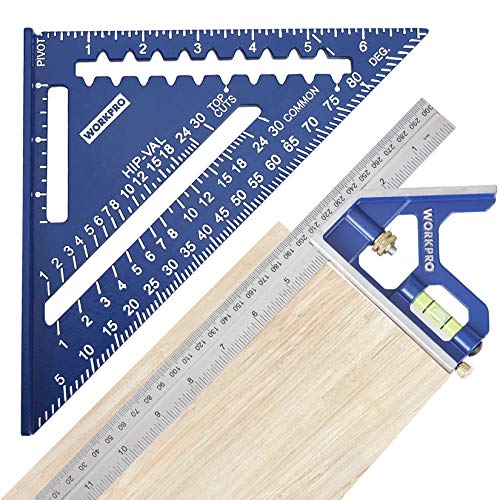
The WORKPRO carpenter square and combination square set brings solid value to homeowners and DIYers who need reliable layout tools without the expense of buying premium brands. The rafter square's heavy-gauge aluminum construction and lipped fence design make it straightforward to hold flush against lumber edges, reducing the guesswork when marking crosscuts, rafter angles, or miter joints. The combination square's 12-inch stainless steel ruler and spring screw mechanism add flexibility for tasks ranging from checking square corners to marking parallel lines.
Readability is a genuine strength here. Both squares feature deep etching and high-contrast markings that remain visible even after years of job-site use or in dim workshop lighting. The multiple graduation options (1/16", 1/32", and 1mm) mean you're not locked into one measurement standard, which is helpful if you work with both imperial and metric plans. The included level vial and metal scriber on the combination square expand its utility beyond basic squaring and layout work.
The main limitation is the lack of user feedback to verify long-term durability and how the spring screw mechanism holds up under repeated use. While the materials and construction appear solid, real-world performance data from homeowners would provide more confidence. For occasional DIY projects and light framing work, this set should perform adequately; heavy-use professionals might want to invest in higher-end alternatives.
| Feature | Details |
|---|---|
| Rafter Square Size | 7 inches |
| Rafter Square Material | Die-cast heavy-gauge aluminum alloy |
| Rafter Square Finish | Low-glare powder coat with white graduations |
| Combination Square Ruler Length | 12 inches |
| Ruler Material | Stainless steel with matte finish |
| Ruler Body Material | Zinc alloy |
| Graduation Scales | 1/16", 1/32", 1mm |
| Markings | Deep etching for legibility and durability |
| Additional Features | Level vial, metal scriber, spring screw mechanism |
| Angle Accuracy | 90 degrees and 45 degrees |
| Rafter Square Functions | Framing square, try square, miter square, protractor square |
Rafter Square: Position the lipped fence flush against the edge of your lumber. The lip prevents the square from sliding, allowing you to mark straight lines perpendicular to the edge or angled lines for rafter cuts. Use the multiple graduation marks to determine angles and proportions for complex cuts.
Combination Square: Loosen the spring screw to slide the ruler to your desired measurement point, then tighten to lock it in place. Use the ruler edge to mark parallel lines, the 90-degree corner for checking square corners, and the 45-degree angle for diagonal marks. The level vial helps verify if a surface is plumb or level.
Metal Scriber: Use the attached scriber to mark layout lines on metal or hardened surfaces where pencil marks won't show clearly. This is especially useful when laying out cuts on sheet metal or marking scribe lines on finished wood.
Keep Markings Visible: Clean the scales regularly with a dry cloth to maintain contrast and readability. Deep etching resists wear, but dust and debris can obscure fine graduations.
Check Accuracy Periodically: Verify your squares against a known-good reference surface every few months, especially if you rely on them for precision work. Minor impacts can affect aluminum's flatness.
Secure the Spring Screw: On the combination square, periodically check that the spring screw is snug. Vibration and repeated adjustments can loosen it over time, so a quick tightening prevents measurement drift during projects.
Use the Lipped Fence: The rafter square's lipped fence is its strongest feature for accuracy. Always position it flush against the workpiece edge rather than floating it above the surface.
Who Should Buy This Set? Homeowners tackling DIY projects, carpenters building decks or fences, and anyone who needs reliable layout tools for framing and crosscutting. The dual-square approach is cost-effective and covers most common layout tasks.
What to Consider: This set is best suited for occasional to moderate use. If you perform heavy-duty framing work daily, consider investing in premium squares with higher-grade materials. The combination square's spring screw mechanism is convenient but requires occasional maintenance.
Alternatives: If you only need a rafter square, buy just that tool. If you prefer a single all-purpose square, a quality combination square alone may suffice. However, this bundled set offers better value if you regularly use both layout styles.
Warranty and Support: Check the manufacturer's warranty details before purchasing. Verify that the retailer offers returns or exchanges if the squares arrive damaged or don't meet your accuracy requirements.

Pros
- Dual-purpose set eliminates need to buy squares separately
- Laser-etched markings won't fade or wear off like stamped alternatives
- Compact trim square fits easily in tool belts and tight work areas
- Pipe cutout feature saves time on plumbing and HVAC layout work
- Durable construction designed to withstand professional-grade use
Cons
- No customer reviews currently available, limiting real-world feedback on durability and performance
- Laser markings, while durable, may be harder to read in direct sunlight compared to contrasting paint fills
Milwaukee's square set pairs a traditional 7-inch rafter square with a compact 4.5-inch trim square, giving carpenters and serious DIYers two essential layout tools in one purchase. The rafter square handles the heavy lifting on framing projects with scribe notches ranging from 1 to 6 inches, while the built-in 1-inch cutout makes it simple to mark around pipes and conduit. The trim square's 35% more compact design makes it ideal for finish carpentry, trim installation, and other detail-oriented tasks where a full-size square would be cumbersome.
The standout feature across both squares is the laser-etched marking system. Unlike stamped or painted markings that fade with jobsite wear, laser etching creates permanent, high-contrast lines that remain readable through years of heavy use. This durability matters when you're working in dusty environments or under direct sunlight, where visibility directly affects accuracy. The markings are crisp and easy to follow, reducing measurement errors and rework.
This set makes sense for homeowners tackling larger renovation projects, DIYers building decks or sheds, and professionals who want reliable, long-lasting layout tools. The limited lifetime warranty backs Milwaukee's confidence in the build quality. Whether you're framing walls, installing trim, or laying out plumbing runs, having both square sizes readily available speeds up workflow and improves precision across different project types.
| Specification | Details |
|---|---|
| Rafter Square Size | 7 inches |
| Trim Square Size | 4.5 inches |
| Scribe Notch Range | 1 to 6 inches |
| Pipe Cutout | 1 inch |
| Marking Method | Laser etched |
| Visibility | High contrast |
| Warranty | Limited lifetime |
| Included Items | 1 Rafter Square, 1 Trim Square |
Rafter Square: Position the 7-inch square along your board edge to mark common rafter angles, roof pitches, and stair stringers. Use the scribe notches (1-6 inches) to mark consistent spacing for layout lines. The 1-inch pipe cutout allows you to scribe around pipes and conduit without repositioning the square.
Trim Square: Use the compact 4.5-inch square for finish carpentry, trim cuts, and detail work where space is limited. It's ideal for marking crosscuts on trim boards, checking 90-degree angles on door and window frames, and layout work in tight corners.
General Tips: Keep both squares clean and dry to maintain marking visibility. Use a sharp pencil or marking knife for precise lines. Store in a dry location to prevent rust on any metal components.
Maximize the Rafter Square: The scribe notches work best for repetitive layouts on framing projects. Mark your first line, then use the notches to space subsequent lines quickly and accurately without remeasuring.
Trim Square Placement: Keep the compact trim square in your front pocket or tool belt for quick access during finish work. Its size makes it faster to grab than a full-size square for single-point checks.
Marking Technique: Use the laser-etched edge as a guide for your pencil. The high-contrast markings make it easy to see exactly where your line will land before you mark, reducing mistakes.
Pipe Cutout Use: When scribing around pipes, position the 1-inch cutout so the pipe sits snugly in the notch, then trace around the square's edge for a perfect fit-line.
Who Should Buy This Set? This two-square combination is ideal for homeowners undertaking deck building, shed construction, or significant remodeling projects. Professional carpenters and framers benefit from having both sizes on hand to reduce tool-swapping time. DIYers who work on multiple project types will appreciate the versatility.
When You Need It: If you're starting a framing project, building stairs, installing trim, or working with plumbing and HVAC layouts, this set covers your square needs. The dual-tool approach saves money compared to buying squares separately.
What to Consider: The laser-etched markings are permanent and durable, but they may require slightly more careful positioning in direct sunlight compared to painted markings. If you work primarily indoors or in shade, this is not a concern. The limited lifetime warranty provides peace of mind for long-term use.

Pros
- Laser-etched markings are durable and easy to read in various lighting conditions
- Scribe notches eliminate the need for separate marking guides on common carpentry tasks
- Angle markings speed up rafter and roof pitch layout without calculator or conversion charts
- Affordable price point for a quality aluminum square from a trusted brand
- Lightweight enough for all-day use without hand fatigue
Cons
- 7-inch size limits its use for larger layout projects that require longer measuring spans
- No reviews currently available to validate real-world durability and long-term performance
The Klein Tools 9357SSQ is a compact aluminum rafter square designed to handle the core layout tasks that carpenters and DIYers face on framing, roofing, and general woodworking projects. The double laser-etched markings are the standout feature here: they remain sharp and legible through heavy use, which matters when you're working in variable lighting or on dusty job sites where visibility matters.
What sets this square apart is the thoughtful integration of practical features. The scribe notches eliminate fumbling with separate pencil guides, the pipe prop keeps materials steady without a helper, and the 0 to 90-degree angle markings let you identify and transfer angles without reaching for a calculator. These aren't revolutionary additions, but they're the kinds of details that save time and reduce frustration on the job.
At 7 inches, this square is genuinely portable and fits naturally into a tool belt or apron pocket, making it ideal for work where you're moving between multiple tasks. The aluminum construction keeps it lightweight without sacrificing durability. For homeowners tackling deck framing, roof repairs, or furniture building, and for professionals who want a reliable secondary square, this Klein Tools model delivers solid value.
| Specification | Detail |
|---|---|
| Brand | Klein Tools |
| Model | 9357SSQ |
| Size | 7 inches |
| Material | Aluminum |
| Markings | Double laser-etched |
| Angle Range | 0 to 90 degrees |
| Scribe Notches | 1/4-inch spacing |
| Additional Features | Pipe prop, angle markings, scribe notches |
| Primary Use | Rafter layout, angle finding, square cuts, woodworking |
Rafter and Angle Layout: Place the square against your workpiece and align the angle markings with your desired pitch or angle. The etched numbers guide you to the correct position without guessing or calculations.
Scribe Marking: Insert your carpenter pencil into the 1/4-inch notches to create evenly spaced lines for layout. Slide the square along your material to mark multiple parallel lines quickly and consistently.
Pipe Propping: Rest metal or plastic pipes in the pipe prop feature to hold them steady while you measure, mark, or cut. This frees up a hand and improves accuracy when working alone.
Square Cuts: Use the 90-degree marking as a reference to mark perpendicular lines on lumber, ensuring clean, accurate crosscuts for framing and assembly work.
Keep Markings Visible: Wipe the laser-etched surface regularly with a dry cloth to maintain visibility. On dusty sites, a quick brush-off ensures the markings stay crisp and readable.
Combine with Other Squares: Use the 9357SSQ as a secondary square alongside a larger framing square. The portability makes it perfect for quick checks and layout work while you keep your primary square at the workbench.
Transfer Angles Accurately: When you need to replicate an angle on another piece, align the square's angle markings on both the original and new material to ensure consistency without measuring tools.
Protect from Moisture: While aluminum resists rust, store the square in a dry location to prevent any oxidation and keep the laser etch sharp over time.
Who Should Buy This: Homeowners tackling deck framing, roof repairs, or furniture projects will find this square invaluable. DIYers who want a reliable, portable layout tool without a hefty price tag benefit from the laser markings and angle guides. Professionals appreciate it as a secondary square for quick on-site layout work.
What to Consider: The 7-inch length is ideal for portability but may feel limiting if you work primarily on large framing projects where longer spans are common. If you need a larger square for extensive layout work, pair this with a full-size framing square. The lack of current user reviews means you're relying on Klein Tools' reputation and the product's feature set rather than extensive field feedback.
Value Proposition: Klein Tools is a well-established brand known for durable hand tools. This square's combination of laser-etched markings, scribe notches, and angle guides offers practical features at an accessible price point, making it a solid entry point for DIYers or a smart addition to any professional's tool collection.

Pros
- Magnetic grip is strong enough to hold the square steady on metal without slipping or rotating
- Scribe notches save time by allowing quick, repeatable marks without measuring each time
- Precision machining delivers consistent, accurate angles for critical carpentry work
- Durable aluminum construction resists rust and corrosion on job sites
- Versatile design works for roofing layouts, stair stringers, and general framing tasks
Cons
- The magnetic feature only works on ferrous metal surfaces, limiting usefulness on wood-only job sites or when working with stainless steel
- At 7 inches, this square is smaller than full-size 12-inch squares, so it may require more careful positioning for larger layout work
The Milwaukee 7-inch magnetic rafter square is engineered for professionals and dedicated DIYers who value precision and efficiency on the job site. The rare earth magnets are notably strong, holding the square securely against steel beams, joists, and metal studs without requiring you to hold it in place. This magnetic feature is a genuine time-saver when you're working solo or need both hands free for marking and measuring.
The precision-machined aluminum body delivers the accuracy you need for critical carpentry applications like rafter layouts, stair stringers, and roof framing. The integrated scribe notches (marked 1 through 6 inches) are a thoughtful design element that eliminates fumbling with a tape measure for repetitive marks. The 1-inch pipe cutout and 1-1/8-inch heel add functional versatility without adding bulk or weight to the tool.
Overall, this rafter square represents solid value for framers and experienced DIYers. It's built to withstand years of jobsite use, and the magnetic design genuinely improves workflow. The main limitation is that the magnets only work on ferrous metals, so you'll need a traditional square for wood-only projects or when working with non-magnetic materials.
| Specification | Detail |
|---|---|
| Brand | Milwaukee Electric |
| Model | 7 Magnetic Rafter Square |
| Size | 7 inches |
| Material | Precision-machined extruded aluminum |
| Magnet Type | Rare earth magnets |
| Heel Size | 1-1/8 inch |
| Pipe Cutout | 1 inch |
| Scribe Notches | 6 notches (1 to 6 inches) |
| Primary Use | Rafter layout, stair stringers, framing |
Magnetic Attachment: Place the square flat against a steel beam, joist, or metal stud. The rare earth magnets will grip firmly, allowing you to position your pencil or marker without holding the square in place.
Scribe Notches: For repetitive marks (like rafter tails or stair treads), use the appropriate notch (1 to 6 inches) as a guide. This eliminates the need to measure each mark individually and ensures consistency across multiple pieces.
Pipe Cutout: The 1-inch cutout prop is designed to help you calculate rafter angles and position the square at the correct pitch. Align the cutout with the pipe or edge you're working with for accurate angle reference.
Heel Positioning: The 1-1/8-inch heel provides a stable reference point on uneven surfaces. Use it to anchor the square firmly before making your marks.
Keep Magnets Clean: Dust and metal shavings can reduce magnetic grip. Wipe the magnet surface regularly with a clean, dry cloth to maintain full holding power.
Combine with Other Tools: Use this square alongside a full-size 12-inch square for layout work that requires larger reference edges. The 7-inch size excels at detail work and tight spaces.
Check Accuracy: Before starting a major project, verify the square's 90-degree angle by checking it against a known accurate reference. Precision-machined squares maintain accuracy, but it's always good practice to confirm.
Jobsite Organization: The compact size makes this square easy to toss in a tool belt or apron. Keep it accessible for quick reference marks throughout the day.
Who Should Buy This? Professional framers, roofers, and serious DIYers who work regularly with metal framing or need a reliable, precision-marked square for layout work. If you're building decks, framing additions, or doing roof work, this square will pay for itself in time saved.
When to Choose a Different Square: If your projects are primarily wood-only construction (like furniture building or fine carpentry), a traditional non-magnetic square may be more practical. The magnetic feature is most valuable when you're working with steel studs, beams, or joists.
Quality Expectation: Milwaukee is known for durable, professional-grade tools. This square is built to last through years of jobsite use. The precision machining ensures consistent accuracy, and the aluminum construction resists corrosion and wear.
Value Consideration: This is a mid-range priced tool that delivers professional-grade performance. It's an investment in accuracy and efficiency that will serve you well across multiple projects.

Pros
- Combination set eliminates need to buy separate squares and rulers, saving money
- Mixed metal construction balances durability with lightweight portability
- Both metric and SAE markings accommodate different measurement preferences
- Textured grip and locking mechanism provide stability on curved or angled surfaces
- Includes carpentry pencil, so you have marking tools ready to go
Cons
- Zero customer reviews available, so real-world durability and accuracy feedback is limited
- Aluminum components may show wear faster than all-steel alternatives with heavy daily use
The GRENPRO Combination Square Woodworking Ruler Set delivers a practical two-in-one solution for homeowners and DIYers tackling carpentry projects. The kit combines a 7-inch aluminum triangle ruler with a 12-inch zinc alloy square, giving you the flexibility to measure angles, verify 90-degree corners, and check straight edges without juggling multiple tools. The mixed metal construction keeps the overall weight down while maintaining structural integrity for typical workshop tasks.
Measurement accuracy depends on clearly marked scales, and this set includes both metric (mm) and SAE (inch) markings across both rulers. The textured edges and locking mechanism are designed to prevent slipping when you're working on angled surfaces or marking wood, which matters when precision counts. The portable, lightweight design makes it easy to toss in a toolbox or keep on a workbench without taking up much space.
This is a solid entry-level option for casual woodworkers and DIYers who want reliable measurement tools without premium pricing. The included 2-in-1 carpentry pencil adds convenience for on-the-spot marking. Keep in mind that aluminum components may show cosmetic wear with intensive daily use in professional shops, but for hobby projects and home improvement work, this set should serve you well.
| Brand | GRENPRO |
| Triangle Ruler Size | 7 inches |
| Square Ruler Size | 12 inches |
| Primary Materials | Aluminum-zinc alloy |
| Measurement Scales | Metric (mm) and SAE (inch) |
| Key Features | Textured edges, locking mechanism, 90-degree verification |
| Included Accessories | 2-in-1 carpentry pencil |
| Weight | Lightweight (exact weight not specified) |
| Intended Use | Woodworking, carpentry, handicraft projects |
Measuring Straight Lines and Edges: Place the 12-inch square ruler flat against your wood surface with the marked edge facing up. Align the ruler with the edge or line you need to measure, then read the scale in either inches or millimeters. Use the textured grip to keep it steady while marking with the included pencil.
Verifying 90-Degree Angles: Position the 12-inch square into the inside corner of your workpiece. The ruler should sit flush against both surfaces with no gaps. If you see daylight between the ruler and either surface, the corner is not square. This is the most common use for combination squares in woodworking.
Measuring Angles: The 7-inch triangle ruler is designed for angled measurements and protractor-style work. Align the ruler with the angle you're measuring and read the degree markings to determine the exact angle. This is useful for bevel cuts, roof pitches, and other angled layouts.
Marking Cut Lines: Use the ruler as a straightedge and mark along the edge with the included 2-in-1 carpentry pencil. The textured edges help prevent the ruler from slipping while you're drawing. For repeated measurements, keep the pencil tip sharp for accuracy.
Secure Your Workpiece: Always clamp or secure your wood before marking or measuring. This prevents the workpiece from shifting and creating inaccurate measurements or dangerous tool slips.
Keep Edges Clear: Metal rulers have sharp edges. Handle them carefully to avoid cuts on your hands. Store them in a tool bag or on a shelf where they won't slide off and cause injury.
Check for Damage: Before use, inspect the rulers for dents, bent edges, or cracks. Damaged measurement tools can give false readings and lead to wasted materials or safety issues during cutting.
Use Proper Lighting: Ensure your workspace is well lit so you can read the measurement scales accurately. Poor visibility leads to measurement errors that compound through your project.
Wear Eye Protection: When marking or measuring near power tools or during cutting operations, wear safety glasses to protect against wood chips and debris.
Mark on the Back Side: When measuring wood that will be visible in the finished project, mark on the back or underside so pencil lines don't show. Use light pressure with the pencil to keep marks minimal.
Combine Both Rulers for Complex Layouts: Use the 12-inch square for straight edges and the 7-inch triangle for angles on the same project. This two-tool approach reduces setup time and keeps your layout consistent.
Store Flat and Dry: Keep your rulers in a dry location to prevent rust on the metal components. Store them flat or upright in a toolbox, not bent or folded, to maintain accuracy over time.
Double-Check Critical Measurements: For important cuts or joints, measure twice with the ruler in different positions. If both readings match, you can be confident in your measurement. This simple habit prevents costly mistakes.
Clean the Scales Regularly: Dust and sawdust can obscure the measurement markings. Wipe the rulers with a dry cloth after use to keep the scales visible and easy to read.
Buying Guide: How to Choose the Right Combination Square
Combination squares look simple, but the differences between a $13 model and a $120 precision instrument are real and significant. The sections below walk through every factor worth considering so you know exactly what you are paying for at each price point.
Blade Length: 6-Inch vs. 12-Inch
Blade length is the first decision most buyers face. A 12-inch blade handles the vast majority of woodworking and carpentry tasks: marking rip cuts, checking door casing, scribing wide panels. A 6-inch blade is more portable and fits neatly in an apron pocket, making it the go-to for electricians, finish carpenters, and anyone working in tight spaces. Sets that include both sizes, like the iGaging Combination Square Set, offer the best flexibility without forcing you to choose. If you can only own one, a 12-inch model covers more situations.
Head Material: Cast Iron, Cast Zinc, and Aluminum
The head is the heart of the tool. Cast iron heads, as found on the Starrett 11H-12-4R, are the gold standard: dense, stable, and resistant to warping under temperature changes. Cast zinc heads are lighter and far more common in mid-range squares, and they perform well for most users as long as you avoid dropping them repeatedly. Aluminum heads, used in some rafter squares, shave weight for overhead work. Plastic components anywhere in the head are a red flag for any square you intend to use seriously.
Blade Material and Graduation Markings
Stainless steel blades resist rust and are standard across most quality squares. Look for graduation markings that are etched or laser-engraved rather than simply printed. Printed markings wear off quickly once the blade gets wet or scratched. The best blades use engraved numbers filled with black or white paint so they remain legible for years. Graduation increments vary: common consumer squares read in 1/8-inch and 1/16-inch increments, while precision models like the Starrett include 4R graduation (reading 1/8, 1/16, 1/32, and 1/64 inch on one blade). If you do fine woodworking or metalwork, finer graduations matter. For general carpentry and framing work, 1/16-inch resolution is more than adequate.
Lock Mechanism
The blade should slide smoothly and lock firmly without play. A loose lock means your measurement shifts the moment you press the square against a workpiece, which defeats the purpose entirely. Better squares use a reversible lock bolt that clamps the blade from either direction, letting you use both the graduated face and the plain back edge. Test the lock by tightening it and trying to wiggle the blade: there should be zero movement. A lock that requires excessive force to tighten or loosens during use is a reliability problem that no amount of brand marketing can paper over.
Built-In Features: Spirit Level, Scriber, and Magnet
Many combination squares include a small spirit level vial in the head, which lets you check for level and plumb without reaching for a separate spirit level. This is a genuine convenience feature rather than a gimmick. A scriber (a small hardened steel pin stored in the head) lets you scratch a fine reference line into metal or wood without a pencil. The Klein Tools 935CSEL adds a magnetic base, which is particularly useful for electricians and metalworkers who need hands-free positioning against steel surfaces. Consider which extras match your actual workflow before treating them as dealbreakers.
Accuracy and Calibration
Accuracy is the one specification that matters above all others in a layout tool. A square that is off by even half a degree compounds into a visible error over twelve inches and a serious problem over the length of a cabinet run or a stair stringer. Premium brands like Starrett machine their heads to much tighter tolerances than budget alternatives. Budget squares from brands like IRWIN and Crescent Lufkin are generally accurate enough for general carpentry and home improvement, but they are not the right choice for precision metalwork or fine instrument making. You can verify your square’s accuracy at home by drawing a line, flipping the square, and checking whether both edges align perfectly with the original line.
Rafter Squares vs. Combination Squares
Several products in our list are rafter squares (also called speed squares or triangle squares) rather than traditional sliding combination squares. Rafter squares like the Milwaukee 7 Magnetic Rafter Square and the Klein Tools 9357SSQ excel at marking consistent angles for roof framing, stair layout, and repetitive crosscuts. They are faster to use for those specific tasks but cannot function as a depth gauge, rule, or scriber the way a combination square can. Understanding which tool fits your primary use case saves you from buying the wrong shape entirely. Many woodworkers and contractors keep both types on hand. For general-purpose work, start with a combination square; add a rafter square when framing or repetitive angle marking becomes a regular need. When cutting trim or molding, pairing a combination square with reliable miter saw techniques produces cleaner results.
Price Range and What to Expect
Budget combination squares offer solid performance for casual home improvement and occasional woodworking. Mid-range models from brands like iGaging and Klein Tools bring tighter tolerances, better materials, and more useful features without requiring a significant investment. At the premium end, tools from Starrett are machined to professional standards and are genuinely meant to last a working lifetime with proper care. Decide honestly how often you use layout tools and how much accuracy your projects demand, then buy accordingly. Overspending on a machinist-grade square for occasional DIY work is just as mismatched as trusting a budget import for precision cabinetry.
Complementary Tools Worth Pairing
A combination square works best as part of a complete layout toolkit. Accurate tape measures and sharp utility knives for scribing lines are natural companions. A good hand saw makes the most of accurate layout marks when power tools are not the right call. For rough framing and structural work, claw hammers and a reliable rafter square round out the toolkit. If your projects involve wall work, a stud finder and a dependable spirit level keep everything plumb and structurally sound.
Why Trust HomeThru
HomeThru is an independent review platform with no financial ties to any manufacturer, retailer, or brand. We do not sell products, handle orders, or process returns. Our editorial team researched and analyzed the combination squares in this guide by reviewing verified buyer feedback across thousands of ratings, examining manufacturer specifications in detail, and comparing real-world performance data reported by professional tradespeople and experienced hobbyists. We consulted published accuracy data, evaluated blade graduation quality, and assessed head construction across each price tier. Products are selected on merit, not on advertising relationships. When we highlight a strength or flag a weakness, it reflects what the evidence actually shows.
Our broader tool coverage spans everything from random orbital sanders to oscillating multi-tools and brad nailers for trim work, all evaluated with the same independent methodology.
Final Thoughts
The right combination square depends on how precise your work needs to be and how often you reach for a layout tool. After carefully researching and comparing every product in this guide, here are our top picks by category:
- Best Overall: IRWIN Combination Square, 12-Inch delivers impressive accuracy, a stainless steel rust-proof blade, and a smooth lock mechanism at a budget-friendly price, making it the right starting point for most woodworkers and DIYers.
- Best Premium Pick: Starrett Steel Combination Square, 12-Inch features a cast iron head, hardened steel blade, 4R graduation markings down to 1/64 inch, and American craftsmanship that professional machinists and serious woodworkers trust for decades of daily use.
- Best Value Set: iGaging Combination Square Set 6-Inch and 12-Inch gives you two high-precision squares with satin chrome blades in a single purchase, making it an outstanding value for anyone who needs both sizes on the bench.
- Best for Electricians and Metalworkers: Klein Tools 935CSEL Combination Square pairs a double-sided stainless steel ruler with a magnetic base and bubble level, purpose-built for trades professionals who work against metal surfaces regularly.
- Best Budget Rafter Square Combo: WORKPRO Aluminum Alloy Carpenter Square and Combination Square Combo bundles a rafter layout tool with a full combination square at a modest price, making it a smart starter kit for anyone outfitting a workshop from scratch.
Whichever model you choose, a combination square is a long-term investment in every layout task you will ever do. Combine it with accurate tape measures, sharp marking tools, and a solid understanding of your project’s tolerance requirements, and your cuts will be cleaner and your assemblies squarer from the very first mark. For larger shop upgrades, it is also worth looking at air compressors and shop vacs to keep your workspace productive and clean.
Frequently Asked Questions
What is the difference between a combination square and a speed square?
A combination square has a sliding blade that locks at any position, letting it function as a ruler, depth gauge, miter marker, and level in one tool. A speed square (rafter square) is a fixed triangle that marks 45- and 90-degree angles quickly and is better suited to repetitive framing cuts. Each serves a different primary purpose.
How do I check whether my combination square is accurate?
Draw a straight line along the blade while the head is pressed against a flat edge, then flip the square and draw a second line from the same reference. If both lines are perfectly parallel with no gap or overlap, the square is true. Any deviation reveals an error in the 90-degree face that will compound across larger workpieces.
Is a 6-inch or 12-inch combination square better for woodworking?
A 12-inch model handles the widest range of woodworking tasks and is the more versatile choice for a primary square. A 6-inch square excels at detail work, fitting in tight spaces, and carrying in an apron pocket. Many experienced woodworkers keep one of each, using the 12-inch for layout and the 6-inch for marking joinery and checking small parts.




Write Your Review
No reviews yet. Be the first to share your experience!