

The air inside your home can be two to five times more polluted than the air outside, according to the EPA, and most people spend more than 90 percent of their time indoors. Volatile organic compounds off-gassing from furniture and cleaning products, carbon dioxide building up in poorly ventilated rooms, fine particulate matter from cooking or candles, and excess humidity that feeds mold growth are all invisible threats you cannot smell or see without help. An indoor air quality monitor turns those invisible risks into real data you can act on, whether that means opening a window, running an air purifier, or dialing back humidity with a basement dehumidifier.
At HomeThru, our editorial team independently researched and evaluated dozens of indoor air quality monitors across a range of price points, sensor configurations, display styles, and connectivity options. We analyzed verified buyer feedback, compared sensor specifications, assessed app ecosystems, and scrutinized real-world usability to narrow the field to the 10 monitors below. Whether you want a budget-friendly plug-in unit for a nursery or a professional-grade multi-sensor device for a whole-home wellness setup, there is an option on this list for you.
Top Indoor Air Quality Monitors We Recommend

Pros
- Large 7-inch display makes air quality data immediately visible and easy to understand at a glance
- External sensors directly sample air for more accurate readings compared to internal-only sensor designs
- Seven customizable AQI alerts help you respond quickly to specific air quality concerns
- Long battery life and portable design allow flexible placement throughout your home
- Simple button controls for time and temperature unit adjustments without complex menus
Cons
- No reviews currently available, so real-world performance feedback from verified buyers is limited
- Sensors require careful handling and should not be touched or exposed to strong perfumes or odors to maintain accuracy
The YNAK 16-in-1 Air Quality Monitor addresses a genuine concern for modern homeowners: understanding what's actually in the air we breathe indoors. With nine distinct parameters measured simultaneously, this device goes beyond basic CO2 monitoring to track particulates (PM1.0, PM2.5, PM10), volatile organic compounds (TVOC), formaldehyde (HCHO), temperature, humidity, and calculated AQI. The external sensor design is particularly noteworthy, as it directly samples ambient air rather than relying solely on internal readings, which can improve accuracy for detecting localized air quality issues.
The 7-inch LED display is genuinely useful for busy households. Rather than requiring users to navigate through menus or pair with a smartphone app, all nine parameters display simultaneously with three brightness levels to suit any room lighting. The seven distinct AQI alert functions provide targeted notifications for different pollutant types, and the mute button prevents alert fatigue. For homeowners monitoring air quality due to allergies, asthma, or general wellness concerns, this immediate visual feedback supports quicker decision-making about ventilation or air purifier use.
Practical considerations matter with any home monitoring device. The 2500mAh battery provides approximately 8 hours of cordless operation, making it suitable for moving between rooms or taking readings in different areas of your home. The USB-C charging standard is convenient and aligns with modern device expectations. Button-based controls for time adjustment and temperature unit switching keep the device functional without smartphone dependency, though the learning curve for these controls is minimal. The included charging cable and adapter ensure you can start monitoring immediately upon unboxing.
| Specification | Details |
|---|---|
| Monitored Parameters | CO2, PM2.5, PM1.0, PM10, HCHO, TVOC, Temperature, Humidity, AQI, Time (9 parameters + 7 alert types) |
| Display | 7-inch LED display with 3 brightness settings |
| Sensor Accuracy | 0.001 units (external high-precision sensors) |
| Temperature Accuracy | ±1 to ±3°F (±0.6 to ±1.7°C) |
| Humidity Accuracy | ±2% to ±3% RH |
| Battery Capacity | 2500mAh |
| Battery Life | Up to 8 hours cordless operation |
| Charging | USB-C cable and adapter included |
| Temperature Display | Switchable between °F and °C |
| Time Format | Switchable between 12-hour and 24-hour |
| Dimensions | 2.95 x 5.59 x 7.91 inches |
| Weight | 1.48 pounds |
| Included Accessories | Air quality monitor, USB-C charging cable, power adapter, user manual |
Getting Started: Fully charge the device using the included USB-C cable and adapter (indicator light will glow red during charging). Power on the device and allow the sensors to stabilize for a few minutes before relying on readings.
Time Setup: Press the 'Time button' once to toggle between 12 and 24-hour formats. Long-press the 'Time button' to enter setup mode. Use the 'Alarm' or 'Brightness' buttons to adjust hours, then press 'Time button' again to adjust minutes. Press 'Time button' once more to confirm and save.
Temperature Unit Switching: Double-press the 'Power button' to switch between Fahrenheit and Celsius displays. This setting will be retained when the device powers on again.
Alert Management: The device provides real-time alerts for air quality concerns. Use the mute button to silence alerts when needed without disabling monitoring. Pay particular attention to alerts for CO2 levels, which indicate ventilation needs.
Sensor Care: Avoid touching the external sensors or exposing them to perfumes, strong cooking odors, or cleaning products, as these can temporarily affect accuracy. Allow the device to stabilize in new environments for several minutes before relying on readings.
Placement Strategy: Position the monitor in the room where you spend the most time (bedroom, office, or living room) for the most relevant air quality data. Avoid placing it directly next to HVAC vents, windows, or doors where drafts could skew readings. For comprehensive home assessment, take readings in multiple rooms at different times of day to identify problem areas.
Interpreting Results: Rising CO2 levels indicate inadequate ventilation—open windows or run exhaust fans. PM2.5 and PM10 spikes often correlate with cooking, candles, or outdoor air infiltration. TVOC and formaldehyde alerts may indicate off-gassing from new furniture or building materials. Use this data to make informed decisions about air purifier placement or ventilation adjustments.
Maintenance and Accuracy: Keep the external sensors clean and free from dust buildup. Check readings after allowing the device to acclimate to a new room for 5-10 minutes. If you notice inconsistent readings, ensure the device hasn't been exposed to strong odors or perfumes, and verify the battery isn't critically low.
Tracking Patterns: Note readings at different times (morning, afternoon, evening) and seasons to understand your home's air quality patterns. This helps identify whether issues are seasonal (outdoor pollen), activity-based (cooking), or persistent (HVAC efficiency).
Is This Monitor Right for You? Choose this device if you want comprehensive, real-time air quality monitoring without smartphone app dependency. It's ideal for homeowners with allergies, asthma, young children, or those concerned about indoor air quality. The large display makes it suitable for anyone who prefers immediate, visible feedback over app-based monitoring.
Key Advantages Over Basic Monitors: Unlike simple CO2-only monitors, this device tracks nine parameters including particulate matter and volatile organic compounds. The external sensor design provides more representative readings than internal-only sensors. The large display and alert system make it more user-friendly than models requiring smartphone interaction.
What to Expect: This is a stationary or semi-portable monitor designed for room-by-room assessment rather than constant hand-held use. The 8-hour battery life suits daily monitoring with regular recharging. Sensor accuracy depends on proper placement away from vents and perfumes. Real-world readings will vary based on activities (cooking, cleaning) and outdoor air infiltration.
Budget Consideration: This mid-range air quality monitor offers comprehensive parameter monitoring at a reasonable price point. The included charging accessories and straightforward controls provide good value compared to models requiring additional purchases or complex app setup.

Pros
- Comprehensive air quality tracking covers the pollutants most homeowners care about, from particulates to chemical off-gassing
- Battery operation eliminates the need for wall outlets, making it practical for renters and those testing multiple locations
- Clear, intuitive display makes air quality data accessible to all household members, not just tech-savvy users
- Affordable entry point for homeowners new to air quality monitoring
Cons
- No Wi-Fi or app connectivity means you cannot monitor readings remotely or receive alerts when air quality drops
- Limited battery life of 9 hours requires frequent recharging if used continuously throughout the day
The KDWKD Indoor Air Quality Monitor is a straightforward, battery-powered device designed for homeowners who want to understand what they're breathing indoors. It measures eight different air quality parameters including CO2 levels, particulate matter (PM2.5, PM10), formaldehyde (HCHO), and volatile organic compounds (TVOC), alongside temperature and humidity. The large color screen displays readings clearly, making it simple to spot when air quality dips due to cooking, pet activity, or inadequate ventilation.
What sets this monitor apart is its portability and ease of use. The built-in rechargeable battery provides up to 9 hours of operation per charge, allowing you to move it between bedrooms, the kitchen, nursery, or office without hunting for outlets. This flexibility is especially valuable for renters or anyone wanting to assess air quality in different zones throughout their home. The compact size means it won't clutter your nightstand or desk, and setup requires nothing more than charging and powering it on.
The monitor excels at identifying common indoor air problems like smoke from cooking, wildfire smoke entering through windows, or off-gassing from new furniture and paint. Homeowners with young children, pets, or respiratory sensitivities will find it helpful for understanding which rooms need better ventilation or air purification. However, this is a standalone device without app connectivity or remote monitoring, so you'll need to physically check the display to see current readings, and you won't receive alerts when air quality deteriorates.
| Specification | Details |
|---|---|
| Measured Parameters | CO2, PM0.3, PM0.5, PM1.0, PM5.0, PM10, HCHO (Formaldehyde), TVOC, Temperature, Humidity |
| Display | Large color screen with AQI levels, temperature, humidity, and battery status |
| Power Source | Built-in rechargeable battery |
| Battery Life | Up to 9 hours per charge |
| Design | Portable, compact, lightweight |
| Intended Use | Bedrooms, nurseries, offices, apartments, living spaces, RVs, hotels |
| Connectivity | None (standalone device, no Wi-Fi or app) |
| Color | White |
Getting Started: Charge the device fully before first use. Press the power button to turn it on. The display will illuminate and begin collecting air quality data within seconds.
Reading the Display: The color screen shows real-time measurements for all tracked parameters. AQI levels are typically color-coded (green for good, yellow for moderate, red for poor), making it easy to interpret air quality at a glance without needing to understand individual pollutant numbers.
Placement Tips: Position the monitor in the area you want to assess, such as your bedroom, baby's room, or office. Keep it away from direct sunlight and heat sources for accurate readings. You can move it between rooms as needed; allow a few minutes in each location for stabilized readings.
Battery Management: Recharge when the battery indicator shows low. The 9-hour runtime works well for daytime use or overnight monitoring; plan charging schedules based on your typical usage patterns.
Who Should Buy This Monitor: Homeowners concerned about indoor air quality, parents of young children, people with allergies or asthma, pet owners, and anyone living in areas affected by wildfire smoke or poor outdoor air quality. Renters will appreciate the portability and lack of installation requirements.
What to Expect: This is a consumer-grade air quality monitor, not laboratory-grade equipment. It provides reliable trend data and alerts you to air quality changes in your home, helping you make informed decisions about ventilation and air purification. It won't give you precise scientific measurements, but it will tell you when your bedroom air is getting stale or when cooking has degraded air quality.
Complementary Products: Consider pairing this monitor with an air purifier for rooms where readings consistently show poor air quality, or a humidifier/dehumidifier if temperature and humidity readings indicate imbalance. Better ventilation habits, such as opening windows when outdoor air quality is good, often work alongside monitoring.
Limitations to Consider: The lack of app connectivity means you cannot set up automated alerts or track air quality trends over weeks and months. If remote monitoring or historical data logging is important to you, consider a Wi-Fi-enabled model instead, though those typically cost more.
Identify Problem Areas: Use the monitor to systematically check different rooms in your home. You may discover that your bedroom accumulates CO2 overnight or that your kitchen air quality drops sharply during cooking. This information helps you prioritize where to improve ventilation.
Track Seasonal Changes: Air quality often varies by season. Monitor readings in winter when homes are sealed tight, and again in spring and fall when windows are open. This helps you understand your home's natural ventilation patterns.
Benchmark Improvements: Take baseline readings before making changes like opening windows, running an air purifier, or improving exhaust fan use. Then monitor again to see the impact of your actions. This makes air quality improvements tangible and motivating.
Battery Charging Strategy: Charge overnight so the device is ready for daytime use. If you plan extended monitoring sessions, keep a power bank or outlet nearby to extend runtime beyond 9 hours.
Placement Matters: Position the monitor in the breathing zone (roughly 3-5 feet high) for most accurate personal exposure readings, rather than on the floor or ceiling. Avoid placing it near heat sources, AC vents, or windows, which can skew readings.
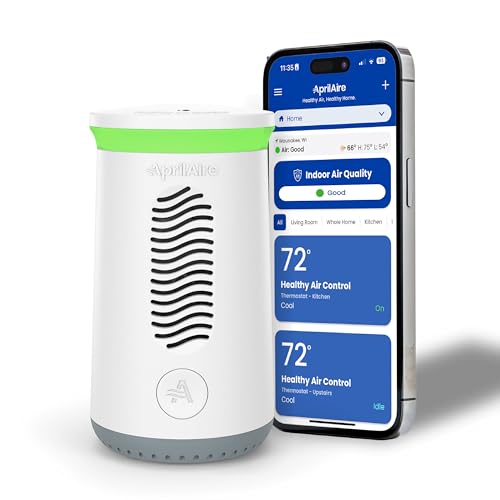
Pros
- Comprehensive five-in-one monitoring eliminates the need for multiple separate sensors
- Smart app integration with real-time alerts keeps you informed from anywhere
- Seamless compatibility with AprilAire's broader Healthy Air System for whole-home improvements
- Expert-backed guidance helps you understand what air quality readings mean and how to fix problems
- Backed by AprilAire's 70-year reputation as an indoor air quality leader
Cons
- Requires AprilAire Healthy Air App to function, so you cannot use the device offline or without a smartphone
- Full smart home automation features require a compatible AprilAire Wi-Fi thermostat, which is sold separately and adds to total cost
The AprilAire ZAWTHCPV Smart Indoor Air Quality Monitor delivers comprehensive home air assessment by measuring five essential factors: CO2 levels, volatile organic compounds (VOCs), PM2.5 particulate matter, humidity, and temperature. This all-in-one approach eliminates the frustration of juggling multiple single-purpose sensors, giving homeowners a clearer picture of their indoor environment. The device uses EPA standards for detection thresholds, ensuring measurements align with public health guidelines rather than arbitrary manufacturer settings.
What sets this monitor apart is its integration with the AprilAire Healthy Air App, which transforms raw data into actionable intelligence. Instead of staring at confusing numbers, you receive expert explanations of what each measurement means, why it matters, and specific steps to improve your air quality. The color-coded status display provides instant visual feedback without requiring app access, while customizable light settings let you choose between always-on, always-off, or default modes depending on your preferences and time of day. Real-time alerts notify you immediately when CO2, VOCs, or other conditions reach unhealthy levels.
For homeowners already invested in AprilAire's ecosystem, this monitor becomes even more powerful. Pairing it with a compatible AprilAire Wi-Fi thermostat enables Healthy Air Mode, which automatically triggers your ventilation and filtration systems when the monitor detects problems. Even without that integration, the monitor's trend tracking and expert guidance make it a valuable tool for understanding your home's air quality patterns and making informed decisions about ventilation, cleaning, or lifestyle adjustments.
| Feature | Details |
|---|---|
| Measurements | CO2, VOCs (TVOC), PM2.5, Humidity, Temperature |
| Connectivity | Wi-Fi enabled with app control |
| Detection Standards | EPA standards for CO2, VOCs, and PM2.5 |
| Display | Color-coded status with three light options |
| Smart Features | Real-time alerts, trend tracking, expert tips |
| Integration | Compatible with AprilAire Wi-Fi thermostats (Models S86WMUPR and 8920W) |
| App Required | AprilAire Healthy Air App |
| Manufacturer | AprilAire (established 1954) |
Setup: Install the monitor in a central location away from direct sunlight, heat sources, or air vents. Download the AprilAire Healthy Air App and follow the on-screen pairing instructions to connect via Wi-Fi.
Daily Monitoring: Check the color-coded display for quick air quality status. Open the app for detailed measurements, trends, and expert recommendations. Enable notifications to receive alerts when any parameter reaches unhealthy levels.
Taking Action: When alerts appear, review the app's guidance on how to improve conditions. This might include opening windows for ventilation, checking HVAC filters, reducing chemical use, or adjusting humidity settings. If you have a compatible AprilAire thermostat, enable Healthy Air Mode to automate ventilation and filtration responses.
Maintenance: Periodically clean the sensor vents with a soft, dry cloth to ensure accurate readings. Check app notifications regularly to stay informed of trends and seasonal changes in your home's air quality.
Who Should Buy This: Homeowners with respiratory concerns, allergies, or asthma; families with young children or elderly members; anyone renovating or concerned about off-gassing; households with pets or cooking-related odors; and those already using AprilAire ventilation or filtration systems.
Key Considerations: This monitor requires the AprilAire app and a Wi-Fi connection to function. You cannot use it as a standalone device with a simple display. If you want automated air quality responses, you'll need to purchase a compatible AprilAire Wi-Fi thermostat separately. However, the monitor provides value on its own through app-based monitoring and expert guidance.
Integration Benefits: If you already own or plan to install AprilAire ventilation, filtration, or humidity control systems, this monitor becomes a central hub for your home's air quality management. The Healthy Air System approach coordinates multiple solutions for comprehensive results.
Budget Planning: Factor in the cost of the monitor plus any compatible AprilAire equipment you may want to add later. Starting with the monitor alone lets you assess your air quality before investing in additional systems.
Placement Matters: Position the monitor in your main living area or bedroom for the most representative readings. Avoid placing it near windows, doors, kitchens, or bathrooms where temporary spikes may not reflect overall home conditions.
Understand Your Baselines: Spend a week observing normal readings before making changes. This helps you identify patterns, seasonal trends, and the impact of specific activities like cooking or cleaning on your air quality.
Act on Trends, Not Just Alerts: The app's trend tracking is as valuable as real-time alerts. Rising CO2 or VOC trends indicate ventilation issues before they become critical. Address gradual increases proactively.
Combine Solutions: Air quality rarely improves with one action. If humidity is high, improve ventilation. If VOCs are elevated, combine better ventilation with reduced chemical use. The app's expert tips guide this multi-pronged approach.
Leverage Seasonal Changes: Use the monitor to identify when your home's air quality shifts with seasons. This helps you plan filter changes, HVAC maintenance, or ventilation adjustments at the right times.

Pros
- Comprehensive monitoring of multiple pollutants helps you identify air quality issues quickly
- Large display and intuitive interface make readings accessible to all family members
- Multi-functional design eliminates the need for separate thermometers and humidity gauges
- Rapid sensor updates every 1-2 seconds provide real-time feedback for immediate action
- Customizable alerts empower you to set thresholds that match your household's needs
Cons
- No user reviews available yet, so real-world reliability and long-term durability remain unverified
- Requires USB-C charging rather than battery operation, limiting placement flexibility in some rooms
The Fil-Fresh 16-in-1 Air Quality Monitor addresses a growing concern for many homeowners: understanding what's actually in the air we breathe indoors. This device evaluates nine distinct parameters including CO2, PM2.5, PM1.0, PM10, formaldehyde (HCHO), and volatile organic compounds (TVOC), alongside temperature, humidity, and time. The real-time detection capability with updates every 1-2 seconds means you're always getting current data, not stale readings from hours ago.
The 7-inch HD display is genuinely large enough to read from across a room, making it practical for bedrooms, nurseries, home offices, or living areas where you want quick visual confirmation of air quality status. The device includes seven customizable AQI alerts that notify you when specific pollutants exceed your preferred thresholds, enabling you to make informed decisions about opening windows, running air purifiers, or adjusting ventilation. The multi-function design also eliminates clutter by replacing separate thermometers and humidity gauges.
Setup and daily use are straightforward, thanks to one-touch operation and an intuitive interface that requires no technical background. The included USB-C charging cable and adapter, combined with adjustable display brightness and temperature unit switching (Fahrenheit or Celsius), make this monitor adaptable to most household preferences. For families prioritizing indoor air quality awareness, this comprehensive monitoring solution provides the transparency needed to maintain a healthier home environment.
| Feature | Details |
|---|---|
| Monitored Parameters | CO2, PM2.5, PM1.0, PM10, HCHO, TVOC, Temperature, Humidity, Time (9 total) |
| Alert Functions | 7 AQI alerts for CO2, PM2.5, PM1.0, PM10, HCHO, TVOC |
| Display Size | 7-inch HD display |
| Update Frequency | Every 1-2 seconds (real-time) |
| Sensor Type | Multiple high-precision sensors with advanced algorithm |
| Temperature Display | Switchable between Fahrenheit and Celsius |
| Power Source | USB-C charging cable with adapter included |
| Display Brightness | Adjustable |
| Included Accessories | Charging adapter, USB-C cable, user manual, FAQ card |
| Ideal Locations | Home, office, bedroom, kitchen, baby room |
Initial Setup: Unpack your Fil-Fresh monitor and connect the USB-C charging cable to the included adapter. Plug into a standard outlet and allow the device to charge fully before first use. Once powered on, the 7-inch display will illuminate with all nine air quality parameters.
Daily Operation: Position the monitor in the room you want to evaluate, whether that's your bedroom, kitchen, nursery, or home office. The device continuously updates readings every 1-2 seconds, so you'll see real-time changes as you open windows or operate air purifiers. Check the display at a glance for current air quality status without needing to press any buttons.
Customization: Use the one-touch controls to adjust display brightness if needed for different lighting conditions. Access the settings menu to switch between Fahrenheit and Celsius temperature display, and set the current time for accurate clock functionality. Configure your preferred AQI alert thresholds so you receive notifications when specific pollutants exceed levels you consider unhealthy for your household.
Maintenance: Keep the monitor in a stable location away from direct sunlight, extreme temperatures, or high moisture areas. Periodically check that the USB-C cable connection remains secure. Clean the display with a soft, dry cloth if dust accumulates on the screen.
Strategic Placement: Position your air quality monitor in the room where your family spends the most time, or rotate it between different areas to assess air quality throughout your home. Bedrooms and nurseries are particularly important locations since poor air quality directly affects sleep quality and children's respiratory health.
Ventilation Decisions: Use the real-time CO2 and PM2.5 readings to guide when to open windows. If CO2 levels climb above 1000 ppm or PM2.5 spikes, that's your signal to increase ventilation. This data-driven approach beats guessing about when fresh air exchange is needed.
Air Purifier Effectiveness: Run your air purifier and watch how the monitor responds over the next 5-10 minutes. This shows you whether your purifier is actually working and how quickly it reduces pollutants in your space. If readings don't improve, it may be time to replace filters or consider a more powerful unit.
Seasonal Monitoring: Air quality changes with seasons. Winter months often show higher indoor CO2 and TVOC because homes are sealed tight. Summer brings in outdoor PM2.5 from pollen and pollution. Track these patterns to anticipate when you'll need extra ventilation or filtration.
Alert Customization: Don't set all alerts to maximum sensitivity or you'll experience constant notifications. Instead, calibrate thresholds based on your household's health priorities. Families with asthma, allergies, or young children should set more conservative limits for PM2.5 and formaldehyde.
Who Should Buy This Monitor? This device is ideal for homeowners concerned about indoor air quality, parents of young children or infants, individuals with respiratory conditions or allergies, and anyone who wants objective data about their home's air. It's particularly valuable if you've recently installed air purifiers and want to verify their effectiveness, or if you're trying to determine whether your ventilation system is adequate.
Key Considerations Before Purchasing: Ensure you have a USB outlet or power strip near your intended installation location, since this monitor requires continuous power via USB-C charging. The 7-inch display needs adequate space on a shelf, desk, or nightstand. Consider whether you want to move it between rooms or keep it in one permanent location. Decide which air quality parameters matter most to your household - this device covers all the major ones, so it's comprehensive regardless of your priorities.
Value Assessment: Compare this monitor's capabilities against standalone CO2 monitors, separate PM2.5 detectors, and individual humidity gauges. The 16-in-1 functionality consolidates multiple tools into one device, reducing overall cost and clutter. The 7-inch display is significantly larger than many competitors, making readings visible from across a room without squinting.
Long-Term Use: This is an investment in understanding your home's air quality for months and years to come. The data you gather helps inform decisions about HVAC maintenance, air purifier placement, window opening schedules, and ventilation improvements. It's particularly valuable during seasons when outdoor air quality is poor or when you're evaluating whether home improvements like new HVAC filters actually make a difference.

Pros
- Comprehensive monitoring covers the pollutants homeowners worry about most, from formaldehyde off-gassing to CO2 buildup
- Visual color-change alerts make it easy to spot air quality problems at a glance without reading numbers
- Long battery life and lightweight design mean you can move it room-to-room or take it on trips without hassle
- Straightforward operation requires no app, WiFi, or technical setup, making it accessible for all skill levels
- Precision sensors deliver consistent data you can trust for making decisions about ventilation and air purification
Cons
- No online reviews available yet, so real-world durability and long-term sensor accuracy remain unverified by homeowners
- Lacks smart home integration or data logging features, so you cannot track trends or set up automated alerts via smartphone
The Zemeollo 10-in-1 air quality monitor addresses a genuine concern for many homeowners: knowing whether the air inside your home is actually safe to breathe. This device evaluates CO2 levels, formaldehyde off-gassing (a concern with new furniture and flooring), volatile organic compounds (TVOC), and particulate matter down to PM0.3, all on a single portable unit. The high-definition color screen displays readings in real time, and the system automatically shifts to warning colors when any parameter exceeds safe thresholds, giving you immediate visual feedback without needing to interpret numbers.
What makes this monitor practical for everyday use is its simplicity. Unlike many air quality devices that require smartphone apps, WiFi setup, or calibration routines, this one powers on and begins monitoring with a single button press. The 2000mAh battery sustains up to 20 hours of continuous operation, which means you can move it from your bedroom to your kitchen to your home office throughout the day without worrying about recharging. The precision sensors use dedicated technology for CO2 detection and electrochemical sensors for formaldehyde and TVOC, with built-in calibration that maintains accuracy over time.
For homeowners investigating indoor air quality issues, whether due to new construction, pet odors, or general ventilation concerns, this device offers a straightforward way to gather data. The lack of smartphone connectivity means you won't get trend analysis or automated alerts, but the immediate visual feedback on the display is often sufficient for deciding whether to open windows, run an air purifier, or investigate potential sources of contamination. The portable design makes it useful for checking multiple rooms and identifying problem areas in your home.
| Specification | Details |
|---|---|
| Brand | Zemeollo |
| Model Type | 10-in-1 Air Quality Monitor |
| Detection Parameters | CO2, HCHO (formaldehyde), TVOC, benzene, PM0.3, PM1, PM2.5, PM10, temperature, AQI |
| Measurement Accuracy | Less than ±5% error margin |
| Display | High-definition color LED screen with automatic color-change alerts |
| Sensor Technology | Smart chip with advanced sensor array; dedicated CO2 sensor; precision electrochemical sensors for HCHO and TVOC |
| Battery | 2000mAh rechargeable lithium-ion |
| Battery Life | Up to 20 hours continuous operation per charge |
| Charging | USB cable included |
| Temperature Units | Switchable between Celsius and Fahrenheit |
| Operation | One-button control; hold 3 seconds to power on/off; 1-second press to toggle temperature units |
| Design | Portable and lightweight |
| Suitable For | Homes, offices, workshops, cars, plant areas, pet areas, hotels |
| Smart Features | Automatic calibration; visual data display system; environmental quality assessment reports |
Getting Started
Remove the device from its packaging and charge the battery using the included USB cable before first use. A full charge typically takes 2-3 hours depending on your power source.
Powering On and Initial Setup
Press and hold the Power button for 3 seconds until the display lights up. The monitor will automatically begin detecting all 10 air quality parameters immediately. The default temperature display is Celsius; if you prefer Fahrenheit, simply press the Power button once for 1 second to toggle between units.
Reading Your Results
Watch the color-coded LED display. Green indicates safe air quality levels, yellow signals caution, and red alerts you to unhealthy conditions. The screen shows real-time readings for CO2, formaldehyde, TVOC, particulate matter, temperature, and overall AQI (Air Quality Index). No additional buttons or menus are needed to view data.
Using in Different Locations
The portable design lets you move the monitor room-to-room or place it in specific areas of concern. Set it on a nightstand to monitor bedroom air quality overnight, place it near your kitchen to check for cooking-related particulates, or put it in your car to evaluate air quality during drives. Allow 1-2 minutes for readings to stabilize in each new location.
Battery Management
With up to 20 hours of battery life per charge, you can monitor continuously throughout the day. Recharge via USB when the battery is low. The device will continue operating at reduced functionality if the battery depletes, but charging is recommended for optimal sensor performance.
Identify Problem Areas in Your Home
Use the monitor to systematically check different rooms and identify where air quality issues are worst. Pay special attention to bedrooms (where you spend 8+ hours), home offices, and kitchens. This data helps you decide where to prioritize ventilation improvements or air purifier placement.
Track Formaldehyde Off-Gassing from New Items
If you've recently brought new furniture, flooring, or carpet into your home, place the monitor nearby and check formaldehyde (HCHO) levels. New materials typically off-gas most heavily in the first few weeks. Increased ventilation during this period can help reduce exposure.
Monitor CO2 as a Ventilation Indicator
High CO2 levels often signal poor ventilation, which can affect focus and sleep quality. If readings consistently exceed 1000 ppm, open windows, run bathroom or kitchen exhaust fans, or consider a ventilation system upgrade.
Check Air Quality Before and After Running Your HVAC System
Compare readings with your heating or cooling system on versus off. This shows you whether your current filtration is effective and helps justify upgrades to higher-MERV filters or whole-house air purifiers.
Use Color Alerts to Motivate Action
The automatic color-change feature makes air quality visible to family members. When the display turns yellow or red, it's a clear signal to open windows or take other corrective action, making air quality management a household habit rather than an afterthought.

Pros
- Comprehensive radon detection with electrochemical sensors trusted by over 1 million users worldwide
- Battery-powered convenience with no wiring or installation hassles required
- Intuitive app provides actionable insights and timely alerts to improve indoor air quality
- Customizable display and flexible placement options fit any home decor
- Secure cloud storage preserves historical data for long-term air quality trend analysis
Cons
- Requires internet connectivity and an Airthings account to function, which may not suit users preferring offline operation
- No reviews currently available, making it difficult to assess real-world user experiences and long-term reliability
The Airthings View Plus delivers professional-grade air quality monitoring in a consumer-friendly package. This battery-powered device measures seven critical indoor air metrics simultaneously, with radon detection as its flagship feature. Given that radon is responsible for more lung cancer deaths than fires and carbon monoxide combined, having accurate detection in your home is genuinely important for your family's health.
Setup is straightforward: power on the device, connect via the Airthings app, and begin receiving real-time data. The customizable e-ink screen shows your chosen metrics without requiring constant power, while the app provides deeper analysis, historical trends, and actionable recommendations. Integration with local pollen forecasts adds another layer of usefulness for those managing allergies or respiratory sensitivities. The cloud-based system securely stores your data, allowing you to spot patterns and make informed decisions about ventilation and air quality improvements.
The cable-free design is a significant practical advantage for homeowners. You can place the monitor in bedrooms, basements, living areas, or any room where radon or air quality concerns exist, without worrying about outlet access. The five-year warranty option provides extended protection for your investment. If you're serious about understanding and improving your home's air quality, this monitor offers the comprehensive measurement and tracking capabilities to justify the investment.
| Feature | Details |
|---|---|
| Measurements | Radon, PM2.5, CO2, VOCs, Humidity, Temperature, Air Pressure |
| Sensor Type | Electrochemical |
| Power Source | Battery-powered (cable-free) |
| Connectivity | WiFi enabled |
| Display | Customizable e-ink screen |
| Operating Temperature | 4 to 40°C (39 to 104°F) |
| App Requirements | Airthings app (requires internet access) |
| Data Storage | Secure cloud-based storage |
| Warranty | Standard warranty; 5-year extended warranty available with free registration |
| User Base | Over 1 million trusted users globally |
Initial Setup: Unbox the View Plus and power it on using the included batteries. Open the Airthings app on your smartphone, create a free account with your email and name, and follow the pairing instructions to connect the device to your WiFi network.
Placement: Position the monitor in the room or area you want to evaluate. Since it's battery-powered, you have complete flexibility—place it in your basement to check radon levels, in your bedroom for sleep quality monitoring, or in your kitchen to track cooking-related VOCs and humidity.
Monitoring: Check the device's e-ink screen for instant readings, or use the app for detailed analysis. Enable notifications to receive alerts when air quality metrics exceed your preferred thresholds. Review trends over time in the app to identify patterns and determine which rooms or times of day have the poorest air quality.
Taking Action: Use the app's recommendations to improve your air quality—opening windows, adjusting ventilation, using air purifiers, or addressing moisture issues. The pollen forecast integration helps you plan outdoor activities and manage allergy symptoms more effectively.
Who Should Buy This: Homeowners in radon-prone regions (particularly the Northeast, Midwest, and Rocky Mountain areas), families with respiratory concerns, and anyone seeking comprehensive insight into their home's air quality will benefit most from this monitor.
Key Considerations: Ensure your home has stable WiFi coverage in the room where you plan to place the device. You'll need to create and maintain an Airthings account to use it. Consider your comfort level with cloud-based data storage and app-dependent operation.
Radon Importance: Radon is a colorless, odorless radioactive gas that seeps into homes from soil and rock. It's the second leading cause of lung cancer after smoking. If you've never tested for radon, this device provides an affordable, continuous monitoring solution that's far more practical than one-time professional testing.
Value Proposition: At this price point, the View Plus offers exceptional value for comprehensive air quality monitoring with a focus on radon detection. The five-year warranty option adds protection and demonstrates manufacturer confidence in the product's durability.
Baseline Your Home: Place the monitor in different rooms over several weeks to establish baseline air quality across your home. This reveals which areas have radon concerns and helps you prioritize ventilation improvements.
Monitor Seasonal Changes: Air quality fluctuates with seasons. Winter typically brings higher radon levels due to closed windows and heating system operation. Track these patterns to understand when your home needs extra attention.
Use VOC Alerts Strategically: The VOC sensor detects kitchen gases, cleaning product fumes, and paint off-gassing. Use this data to guide when you ventilate during household projects and which products to use or avoid.
Leverage Trend Data: Don't just check readings daily—examine monthly and seasonal trends in the app. This long-term perspective reveals whether your air quality improvements (new ventilation, air purifier, radon mitigation) are actually working.
Integrate with Smart Home: If you have smart home automation, consider pairing this monitor with smart ventilation fans or air purifiers that activate when CO2 or PM2.5 levels spike, creating an automated air quality management system.

Pros
- Measures multiple air quality parameters simultaneously, giving you a complete picture of your indoor environment rather than isolated data points
- Free smartphone app with push notifications helps you respond quickly to air quality issues and track improvements over time
- Specifically designed to detect CO2 buildup, which directly impacts focus and productivity in home offices and study areas
- Humidity and particulate tracking makes it effective at identifying conditions that encourage mold growth
- Simple setup and intuitive interface makes it accessible for all users without technical expertise
Cons
- No reviews currently available, so real-world user feedback on long-term reliability and sensor accuracy is not yet established
- Requires smartphone and app connectivity for full functionality and alerts, which may not suit users preferring standalone operation
The BREATHE Airmonitor Plus stands out in the indoor air quality market by combining multiple sensor technologies in one compact device. Rather than forcing you to choose between a CO2 monitor, a particle counter, or a VOC detector, this unit measures all of them simultaneously, along with formaldehyde, temperature, and humidity. This comprehensive approach gives homeowners and office workers a genuine understanding of what's happening in their indoor air, making it possible to identify specific pollution sources and take targeted action.
The smartphone app integration is where this monitor truly shines for daily use. Real-time alerts notify you when CO2 levels spike during work sessions or when particulate matter rises during cooking, while the 30-day history feature lets you spot patterns and trends. This data-driven approach is particularly valuable for families with allergies, individuals concerned about mold risk, or remote workers looking to optimize their workspace for focus and productivity. The calibration tools are straightforward enough that setup takes about 30 seconds, and the clean visual graphs make the information immediately actionable.
The device is purpose-built for health-conscious homeowners who want to move beyond guesswork. Whether you're concerned about ventilation during winter months, want to monitor air quality while cooking, or need to track conditions in a basement prone to humidity, the multi-sensor approach provides the insights necessary to make informed decisions about your home's indoor environment. The compact design means it won't look out of place on a desk, shelf, or nightstand.
| Parameter | Details |
|---|---|
| CO2 Measurement | Precision CO2 sensor with quick calibration |
| Particulate Detection | PM1, PM2.5, PM10 sensors |
| Gas Detection | TVOC (Total Volatile Organic Compounds) and formaldehyde (HCHO) |
| Environmental Sensors | Temperature and humidity monitoring |
| App Connectivity | Free BREATHE Tech app with remote monitoring |
| Alerts | Instant notifications for air quality changes |
| Data History | 30-day trend tracking and graphical display |
| Calibration | Built-in quick-calibration tools with clear instructions |
| Design | Modern compact form factor for home, office, and bedroom use |
| Setup Time | Under 30 seconds via app |
Setup: Download the free BREATHE Tech app on your smartphone and connect the Airmonitor Plus via the app in under 30 seconds. The intuitive interface guides you through the pairing process with clear on-screen instructions.
Calibration: The device includes built-in quick-calibration tools for CO2, VOC, formaldehyde, and temperature. Follow the included instructions to calibrate once during initial setup. The monitor will then provide accurate readings continuously.
Daily Monitoring: Place the device in your target area (bedroom, office, kitchen, or living room) and let it continuously monitor air quality. Check the app regularly to review real-time readings and 30-day trends. Use the visual graphs to identify patterns tied to cooking, cleaning, occupancy, or HVAC cycles.
Taking Action: When alerts notify you of high CO2, particulates, or VOCs, use the data to make adjustments. Open windows for ventilation, reduce use of cleaning products, or check your HVAC system. Track whether your changes improve the readings over time using the historical data feature.
Optimize for CO2 Focus: Place the monitor in your home office or study area to track CO2 buildup during long work sessions. Most people notice concentration improves when CO2 levels stay below 1000 ppm. Use the app alerts as a reminder to open a window or step outside for fresh air breaks.
Identify Pollution Sources: Watch the app during your normal activities. You'll quickly learn which of your habits trigger particulate or VOC spikes - cooking methods, cleaning products, candles, air fresheners, or hobby activities. This knowledge helps you make targeted improvements.
Mold Prevention: Use the humidity and particulate tracking features together to catch mold-prone conditions early. High humidity combined with particulate matter often precedes visible mold growth. Address these conditions before they become problems.
Seasonal Adjustments: Review your 30-day history as seasons change. Winter months often show higher CO2 due to sealed windows, while summer may reveal humidity spikes. Use these patterns to plan ventilation strategies and HVAC adjustments.
Bedroom Placement: Monitor your bedroom overnight to understand how sleep quality relates to CO2 and humidity levels. Many people sleep better when CO2 stays low and humidity stays in the 40-60% range.
Who Should Buy This: The BREATHE Airmonitor Plus is ideal for homeowners with allergies, families concerned about indoor air quality, remote workers optimizing focus, parents monitoring children's study environments, and anyone concerned about mold risk or ventilation issues. It's also valuable for people with respiratory sensitivities or those living in areas with poor outdoor air quality.
What Makes This Different: Unlike basic CO2-only monitors or simple particle counters, this device measures eight parameters simultaneously. This comprehensive approach reveals the full picture of your indoor environment rather than isolated data points. The smartphone app with historical tracking transforms raw data into actionable insights.
Key Considerations: This device requires smartphone connectivity to access alerts and historical data. If you prefer a completely standalone monitor with a built-in display, you may want to evaluate alternatives. However, the app functionality is genuinely useful for understanding trends and identifying pollution sources over time.
Value Proposition: Professional-grade multi-sensor air quality monitors typically cost significantly more. The BREATHE Airmonitor Plus delivers comprehensive monitoring at a price point accessible to most homeowners, making indoor air quality assessment practical rather than a specialized luxury.

Pros
- Exceptionally long battery life eliminates the need for frequent charging or cable management
- NDIR sensor technology ensures highly accurate and reliable CO2 measurements
- Intuitive color coding and large display numbers make air quality status instantly clear
- Comprehensive app provides detailed historical data and trends for informed decision-making
- Compact and portable design works in homes, offices, schools, and any indoor space
Cons
- No reviews currently available on the product page, making it difficult to assess real-world user experiences
- App data history limited to 90 days, which may not be sufficient for long-term air quality trend analysis
The Aranet4 Home delivers a straightforward solution for monitoring indoor air quality without the clutter of cables or constant battery replacements. Its NDIR infrared sensor technology provides the precision you'd expect from a professional-grade device, while the e-ink display keeps power consumption minimal and readable at all times. The color-coded interface and prominent CO2 number mean you can assess your indoor air at a glance, making it practical for busy households and workspaces.
What sets this monitor apart is its wireless independence. With up to 4 years of battery life, you install it once and largely forget about maintenance. The optional buzzer adds an audible alert when CO2 levels climb too high, which is especially useful in bedrooms, classrooms, or offices where poor ventilation can affect concentration and mood. The device measures not just CO2 but also temperature, humidity, and atmospheric pressure, giving you a complete picture of your indoor environment.
The free companion app transforms raw data into actionable insights by displaying 90 days of historical trends through interactive graphs. This allows you to identify patterns, such as when CO2 peaks during work hours or sleep, and adjust ventilation accordingly. Built in the European Union with premium materials, the Aranet4 Home is designed to be a reliable long-term investment in your household's air quality and occupant health.
| Specification | Details |
|---|---|
| Brand | SAF (Aranet) |
| Model | Aranet4 Home |
| Sensor Type | Nondispersive Infrared (NDIR) |
| Measurements | CO2 levels, temperature, relative humidity, atmospheric pressure |
| Display | E-ink screen with color coding |
| Power | Battery powered (wireless) |
| Battery Life | Up to 4 years |
| Data History | 90 days via smartphone app |
| Alerts | Color-coded display, optional buzzer |
| App Features | Interactive graphs, data analysis, configuration |
| Portability | Compact and portable |
| Manufacturing | Made in European Union |
| Use Cases | Home, office, school, any indoor space |
Setup and Placement: Unbox the Aranet4 Home and place it in a central location where you spend the most time, such as a bedroom, living room, or office. The device requires no installation or wiring. Position it away from direct sunlight, heat sources, and air vents for the most accurate readings. Allow the sensor to stabilize for a few minutes before relying on readings.
Reading the Display: The e-ink screen displays CO2 concentration as a large, easy-to-read number. The background color changes based on air quality: green indicates good air quality, yellow signals moderate levels, and red warns of elevated CO2. Consult the app or device manual for specific CO2 threshold values that define each color zone.
Using the App: Download the free Aranet app on your smartphone and follow the pairing instructions to connect your device. Once linked, you can view real-time data, access 90 days of historical records, and generate graphs to identify air quality trends. Enable the optional buzzer alarm in the app settings if you want audible notifications when CO2 levels exceed your preferred threshold.
Monitoring and Adjusting: Check the display regularly, especially in bedrooms before sleep and in work areas during the day. When CO2 levels rise, increase ventilation by opening windows, using exhaust fans, or adjusting HVAC settings. The app's historical data helps you correlate activities and times of day with air quality changes, allowing you to optimize your indoor environment for better focus and health.
Who Should Buy This Monitor? The Aranet4 Home is ideal for homeowners concerned about indoor air quality, remote workers seeking to optimize focus, parents monitoring air in children's bedrooms or play areas, educators managing classroom ventilation, and anyone with respiratory sensitivities or allergies. It's also valuable for those recovering from illness or managing long-term health conditions where air quality directly impacts well-being.
Key Considerations: Before purchasing, think about where you'll place the monitor. Central locations like living rooms and bedrooms are best for whole-home assessment. Consider whether you want the optional buzzer alarm for notifications. The 90-day app history is sufficient for identifying weekly and monthly patterns but won't track seasonal changes over a year. If you need longer data retention, plan to manually export or screenshot important trends.
Comparing CO2 Monitors: The Aranet4 Home stands out for its exceptional battery life, NDIR sensor accuracy, and premium European manufacturing. Unlike cheaper models, it doesn't require constant charging or replacement batteries every few months. The free app with interactive graphs provides insights that basic models lack. If you need Wi-Fi connectivity for remote monitoring or cloud storage of data beyond 90 days, research models with those capabilities, though they typically require power outlets.
Installation and Maintenance: No professional installation is needed. Simply place the device and pair it with your phone. Maintenance is minimal since there are no filters to replace or cables to manage. The battery lasts years, so you won't need frequent upkeep. Occasionally wipe the screen with a soft cloth to keep it clean and readable.
Optimize Placement for Accuracy: Position the Aranet4 Home at least 6 inches away from walls, windows, and air vents. Avoid placing it near doors where drafts cause fluctuations or near heat sources that affect temperature readings. In multi-room homes, consider placing it in your most-occupied space first, then moving it periodically to assess air quality in different areas. Keep it at roughly chest height for the most representative readings of the breathing zone.
Establish Baseline Readings: Spend the first week recording typical CO2 levels throughout your day. Note readings when windows are closed versus open, during occupied versus empty periods, and in different seasons. This baseline helps you understand your home's natural air quality patterns and identify when ventilation adjustments are truly needed versus normal fluctuations.
Use Color Codes Strategically: If you have family members or roommates, explain what the colors mean and agree on action thresholds. For example, when the display turns yellow, open a window or run an exhaust fan. This creates a shared understanding of air quality and encourages proactive ventilation habits without constant monitoring.
Leverage App Data for Health Insights: Review your 90-day history monthly to spot trends. If CO2 consistently rises during sleep, consider cracking a window or improving bedroom ventilation. If it peaks during work hours, adjust your office setup or break routine. Use these insights to make targeted improvements that directly benefit your focus, sleep quality, and overall health.
Battery Life Longevity: To maximize the 4-year battery life, keep the device in moderate temperature environments and avoid extreme heat or cold. The e-ink display is already power-efficient, so there are no settings to adjust for battery savings. Simply let it run and enjoy years of worry-free monitoring.

Pros
- Fast 2-second data refresh provides real-time air quality updates instead of delayed readings
- Integrates seamlessly with GoveeLife ecosystem to automate air purifiers and humidifiers based on actual air quality
- Two years of cloud storage and export functionality helps identify seasonal air quality patterns and trends
- Multiple display modes and color-coded LED indicators make it easy to understand air quality status instantly
- High sensor accuracy across all three measurements ensures reliable data for health-conscious homeowners
Cons
- Requires constant power connection via USB Type-C, limiting placement flexibility in homes without nearby outlets
- No built-in battery means it cannot function during power outages or provide portable monitoring
The GoveeLife Smart Air Quality Monitor H5106 delivers real-time indoor air quality data with impressive speed and accuracy. The 2-second refresh rate means you'll see PM2.5 changes almost instantly, rather than waiting for delayed readings from slower monitors. The sensor accuracy across PM2.5, temperature, and humidity is solid for a device in this category, making it reliable for homeowners who want to understand their indoor environment.
What sets this monitor apart is its tight integration with the broader GoveeLife smart home ecosystem. Once connected, it can automatically trigger compatible air purifiers, humidifiers, and fans to turn on or off based on your air quality targets. This automation takes the guesswork out of when to run these appliances and helps optimize energy use. The switchable LED display with multiple viewing modes is thoughtfully designed, and the ability to access 13-day graphs and export 2 years of historical data gives you meaningful insights into your home's air quality patterns.
The main trade-off is that this monitor must remain plugged in at all times via USB Type-C, so placement depends on outlet availability. There's no battery backup, which means power outages will interrupt monitoring. If you're looking for a portable air quality monitor, this isn't it. However, for a permanent installation in a bedroom, office, or living room where you want continuous smart home automation, the GoveeLife monitor offers solid value and functionality.
| Specification | Details |
|---|---|
| Model | H5106 |
| Brand | GoveeLife |
| Measured Parameters | PM2.5, Temperature, Humidity |
| PM2.5 Accuracy | ±15 µg/m³ |
| Temperature Accuracy | ±0.54°F |
| Humidity Accuracy | ±3% RH |
| Data Refresh Rate | 2 seconds |
| Display Type | LED with switchable modes |
| Display Modes | Clock & PM2.5, Bright mode, Night mode |
| Connectivity | WiFi 2.4G, Bluetooth |
| Power Source | USB Type-C (wired, no battery) |
| Data Storage | 2 years cloud storage |
| Data Viewing | 13-day graphical history, export capability |
| Compatible Devices | GoveeLife air purifiers (H7126, H7120, H7124, H712C, H7122, H7123), humidifier (H7140), fans (H7100, H7102) |
Automation Benefits
The GoveeLife H5106 shines when integrated with compatible smart appliances. Set your target air quality levels, and connected devices automatically respond to real-time changes. For example, when PM2.5 spikes, your air purifier turns on without manual intervention. When humidity drops, the humidifier activates. This automation reduces energy waste and maintains healthier indoor conditions consistently.
Compatible Devices
This monitor works with a specific range of GoveeLife products: air purifiers (models H7126, H7120, H7124, H712C, H7122, H7123), the H7140 humidifier, and fans (H7100, H7102). If you already own compatible GoveeLife appliances, this monitor becomes a central hub for your air quality ecosystem. If not, consider whether you plan to expand your GoveeLife setup before purchasing.
Remote Monitoring
Access air quality data remotely via the GoveeHome app over WiFi or Bluetooth. View 13-day historical graphs and export up to 2 years of data for analysis. This remote capability is useful for homeowners who travel or want to monitor conditions in multiple rooms from a central location.
Who Should Buy This Monitor
This is ideal for homeowners with existing GoveeLife smart appliances, allergy sufferers who want to track PM2.5 trends, or anyone serious about understanding indoor air quality. It's also well-suited for home offices, bedrooms, and living spaces where you want continuous monitoring and automation.
Who Should Look Elsewhere
If you need portability, a battery-powered option is better. If your smart home is built on a different ecosystem (Apple HomeKit, Google Home, Alexa), check compatibility first, as this monitor is optimized for GoveeLife devices. If you want a simple, non-connected air quality monitor without smart features, a basic PM2.5 detector will cost less.
Installation Considerations
Plan placement near an available USB Type-C outlet for continuous power. Keep the sensor clear of obstructions and away from direct sunlight or heat sources for accurate readings. Ensure your WiFi network is stable and within range for reliable cloud connectivity and automation triggers.

Pros
- Comprehensive 16-parameter monitoring gives you a complete picture of indoor air quality, not just PM2.5
- Fast 3-second refresh rate means you see real-time changes in air quality as you open windows or run an air purifier
- Portable with excellent battery life, so you can move it between rooms or take it in your car without constant recharging
- Large, color display is easy to read at a glance without needing to pull out your phone
- Simple one-button interface requires no learning curve or app setup
Cons
- 4-5 hour battery life limits all-day monitoring in a single location without recharging, especially if you want continuous overnight tracking
- No app connectivity or data logging means you cannot review historical air quality trends or receive alerts when away from home
The AirWhisper 16-in-1 Air Quality Monitor stands out for its comprehensive approach to indoor air assessment. Unlike basic PM2.5-only monitors, this device evaluates 16 different air quality parameters including particulate matter, CO2 levels, volatile organic compounds (TVOC), and formaldehyde concentrations. The high-precision sensor system refreshes data every 3 seconds, giving you real-time visibility into how your indoor environment changes as you open windows, run appliances, or adjust ventilation. This responsiveness is particularly valuable in bedrooms, nurseries, and home offices where air quality directly affects comfort and health.
The user experience is refreshingly straightforward. A single button powers the unit on and off, switches between Celsius and Fahrenheit, and controls the mute function with a double-tap. The large color display presents all metrics clearly without requiring a smartphone app or complicated menu navigation, making it accessible to users of all technical skill levels. The seven AQI alert types with audible buzzer give you immediate feedback when air quality drops, though you can mute alerts when needed. The portable design with 4-5 hours of battery life and fast USB-C charging allows you to move the monitor between rooms or even monitor air quality in your vehicle.
For homeowners evaluating this monitor, consider your primary use case. If you want to track air quality trends over days or weeks, or receive alerts while away from home, you'll need to supplement this device with an app-connected alternative. The lack of data logging and cloud connectivity means this works best as a real-time assessment tool for immediate decisions about ventilation and air purification. The 12-month warranty provides reasonable coverage, and the sleek Frost Moon White design fits naturally into modern home decor without looking clinical or industrial.
| Parameter | Details |
|---|---|
| Air Quality Metrics | PM1.0, PM2.5, PM10, CO2, TVOC, HCHO (formaldehyde), temperature, humidity |
| Total Parameters Monitored | 16-in-1 |
| Data Refresh Rate | Every 3 seconds |
| Display | HD color display |
| Alerts | 7 types of AQI alerts with audible buzzer |
| Mute Function | Double-click to silence alerts |
| Battery Life | 4-5 hours per charge |
| Charging | USB Type-C fast charging |
| Operating Modes | Home, car, nursery, office, public spaces |
| Temperature Display | Switchable between C and F |
| Design | Portable with mounting options |
| Color | Frost Moon White |
| Warranty | 12 months |
Getting Started: Unbox the AirWhisper and charge it fully using the included USB Type-C cable and adapter. This typically takes 1-2 hours. Once charged, press the single button on the device to power it on. The large color display will illuminate and begin displaying air quality readings within seconds.
Daily Monitoring: Place the monitor in the area you want to assess - your bedroom, nursery, office, or car. The device will continuously update air quality data every 3 seconds. Watch for the AQI alert indicators on the display; if air quality drops, the buzzer will sound and visual alerts will appear. If you're in a meeting or sleeping, double-click the button to mute alerts temporarily without turning off the monitor.
Switching Modes: Press the button once to power on/off, and use additional presses to toggle between temperature units (Celsius/Fahrenheit). The device automatically detects which metrics are most relevant based on your environment and displays them prominently on the HD screen.
Recharging: When battery runs low (typically after 4-5 hours of continuous use), connect the USB Type-C cable to any standard power adapter. Keep the included charging cable accessible so you can top up the battery between monitoring sessions in different locations.
Who Should Buy This: The AirWhisper is ideal for parents concerned about nursery air quality, allergy sufferers wanting real-time pollution data, and homeowners planning to run air purifiers or adjust ventilation. It's also useful for anyone evaluating a new home, apartment, or office space before moving in.
Key Considerations: This monitor excels at real-time assessment but doesn't store historical data or connect to apps. If you need to track air quality trends over weeks or months, you'll want a device with cloud connectivity. The 4-5 hour battery life is sufficient for monitoring one room at a time, but you'll need to recharge frequently if you move it between multiple locations throughout the day.
Best Use Cases: Use this device to identify problem areas in your home (stuffy bedrooms, kitchens with cooking odors, basements with moisture issues). Monitor air quality before and after opening windows or running an air purifier to see the impact of your ventilation changes. Take it with you when visiting new spaces to assess air quality before spending extended time there. The portable design makes it perfect for renters who can't install permanent air quality systems.
Complementary Products: Pair this monitor with an air purifier to see real-time improvements in PM2.5 and TVOC levels. Use it alongside a humidity meter in basements or bathrooms to track moisture-related air quality issues. Consider it a diagnostic tool to determine whether you need permanent indoor air quality solutions.
Placement Strategy: Position the monitor at breathing height (roughly 3-5 feet off the ground) in the center of the room you're assessing, away from walls, doors, and air vents. This gives the most representative reading of the air you're actually breathing. Avoid placing it directly next to air purifiers, as the concentrated clean air stream will skew readings and won't reflect your overall room air quality.
Identifying Problem Areas: Move the monitor between different rooms over several days to create a mental map of your home's air quality. You'll likely discover that bedrooms have higher CO2 levels (due to closed doors and breathing), kitchens spike in TVOC during cooking, and basements may show elevated humidity. Use these insights to prioritize ventilation improvements.
Maximizing Battery Life: Keep the monitor on a desk or shelf rather than constantly moving it between rooms. Each relocation requires recharging, so batch your monitoring sessions by location. Mute alerts during sleeping hours to reduce unnecessary buzzer activity, which doesn't drain battery but helps you sleep better.
Interpreting the Data: PM2.5 levels above 35 micrograms per cubic meter indicate unhealthy air quality; below 12 is excellent. CO2 above 1000 ppm suggests you need better ventilation. TVOC and formaldehyde readings help identify off-gassing from new furniture or flooring. Use the device as a diagnostic tool to understand your home's air quality patterns, then make targeted improvements like opening windows, running air purifiers, or improving HVAC maintenance.
Pros
- Comprehensive radon detection with electrochemical sensors trusted by over 1 million users worldwide
- Battery-powered convenience with no wiring or installation hassles required
- Intuitive app provides actionable insights and timely alerts to improve indoor air quality
- Customizable display and flexible placement options fit any home decor
- Secure cloud storage preserves historical data for long-term air quality trend analysis
Cons
- Requires internet connectivity and an Airthings account to function, which may not suit users preferring offline operation
- No reviews currently available, making it difficult to assess real-world user experiences and long-term reliability
The Airthings View Plus delivers professional-grade air quality monitoring in a consumer-friendly package. This battery-powered device measures seven critical indoor air metrics simultaneously, with radon detection as its flagship feature. Given that radon is responsible for more lung cancer deaths than fires and carbon monoxide combined, having accurate detection in your home is genuinely important for your family's health.
Setup is straightforward: power on the device, connect via the Airthings app, and begin receiving real-time data. The customizable e-ink screen shows your chosen metrics without requiring constant power, while the app provides deeper analysis, historical trends, and actionable recommendations. Integration with local pollen forecasts adds another layer of usefulness for those managing allergies or respiratory sensitivities. The cloud-based system securely stores your data, allowing you to spot patterns and make informed decisions about ventilation and air quality improvements.
The cable-free design is a significant practical advantage for homeowners. You can place the monitor in bedrooms, basements, living areas, or any room where radon or air quality concerns exist, without worrying about outlet access. The five-year warranty option provides extended protection for your investment. If you're serious about understanding and improving your home's air quality, this monitor offers the comprehensive measurement and tracking capabilities to justify the investment.
| Feature | Details |
|---|---|
| Measurements | Radon, PM2.5, CO2, VOCs, Humidity, Temperature, Air Pressure |
| Sensor Type | Electrochemical |
| Power Source | Battery-powered (cable-free) |
| Connectivity | WiFi enabled |
| Display | Customizable e-ink screen |
| Operating Temperature | 4 to 40°C (39 to 104°F) |
| App Requirements | Airthings app (requires internet access) |
| Data Storage | Secure cloud-based storage |
| Warranty | Standard warranty; 5-year extended warranty available with free registration |
| User Base | Over 1 million trusted users globally |
Initial Setup: Unbox the View Plus and power it on using the included batteries. Open the Airthings app on your smartphone, create a free account with your email and name, and follow the pairing instructions to connect the device to your WiFi network.
Placement: Position the monitor in the room or area you want to evaluate. Since it's battery-powered, you have complete flexibility—place it in your basement to check radon levels, in your bedroom for sleep quality monitoring, or in your kitchen to track cooking-related VOCs and humidity.
Monitoring: Check the device's e-ink screen for instant readings, or use the app for detailed analysis. Enable notifications to receive alerts when air quality metrics exceed your preferred thresholds. Review trends over time in the app to identify patterns and determine which rooms or times of day have the poorest air quality.
Taking Action: Use the app's recommendations to improve your air quality—opening windows, adjusting ventilation, using air purifiers, or addressing moisture issues. The pollen forecast integration helps you plan outdoor activities and manage allergy symptoms more effectively.
Who Should Buy This: Homeowners in radon-prone regions (particularly the Northeast, Midwest, and Rocky Mountain areas), families with respiratory concerns, and anyone seeking comprehensive insight into their home's air quality will benefit most from this monitor.
Key Considerations: Ensure your home has stable WiFi coverage in the room where you plan to place the device. You'll need to create and maintain an Airthings account to use it. Consider your comfort level with cloud-based data storage and app-dependent operation.
Radon Importance: Radon is a colorless, odorless radioactive gas that seeps into homes from soil and rock. It's the second leading cause of lung cancer after smoking. If you've never tested for radon, this device provides an affordable, continuous monitoring solution that's far more practical than one-time professional testing.
Value Proposition: At this price point, the View Plus offers exceptional value for comprehensive air quality monitoring with a focus on radon detection. The five-year warranty option adds protection and demonstrates manufacturer confidence in the product's durability.
Baseline Your Home: Place the monitor in different rooms over several weeks to establish baseline air quality across your home. This reveals which areas have radon concerns and helps you prioritize ventilation improvements.
Monitor Seasonal Changes: Air quality fluctuates with seasons. Winter typically brings higher radon levels due to closed windows and heating system operation. Track these patterns to understand when your home needs extra attention.
Use VOC Alerts Strategically: The VOC sensor detects kitchen gases, cleaning product fumes, and paint off-gassing. Use this data to guide when you ventilate during household projects and which products to use or avoid.
Leverage Trend Data: Don't just check readings daily—examine monthly and seasonal trends in the app. This long-term perspective reveals whether your air quality improvements (new ventilation, air purifier, radon mitigation) are actually working.
Integrate with Smart Home: If you have smart home automation, consider pairing this monitor with smart ventilation fans or air purifiers that activate when CO2 or PM2.5 levels spike, creating an automated air quality management system.
Pros
- Measures multiple air quality parameters simultaneously, giving you a complete picture of your indoor environment rather than isolated data points
- Free smartphone app with push notifications helps you respond quickly to air quality issues and track improvements over time
- Specifically designed to detect CO2 buildup, which directly impacts focus and productivity in home offices and study areas
- Humidity and particulate tracking makes it effective at identifying conditions that encourage mold growth
- Simple setup and intuitive interface makes it accessible for all users without technical expertise
Cons
- No reviews currently available, so real-world user feedback on long-term reliability and sensor accuracy is not yet established
- Requires smartphone and app connectivity for full functionality and alerts, which may not suit users preferring standalone operation
The BREATHE Airmonitor Plus stands out in the indoor air quality market by combining multiple sensor technologies in one compact device. Rather than forcing you to choose between a CO2 monitor, a particle counter, or a VOC detector, this unit measures all of them simultaneously, along with formaldehyde, temperature, and humidity. This comprehensive approach gives homeowners and office workers a genuine understanding of what's happening in their indoor air, making it possible to identify specific pollution sources and take targeted action.
The smartphone app integration is where this monitor truly shines for daily use. Real-time alerts notify you when CO2 levels spike during work sessions or when particulate matter rises during cooking, while the 30-day history feature lets you spot patterns and trends. This data-driven approach is particularly valuable for families with allergies, individuals concerned about mold risk, or remote workers looking to optimize their workspace for focus and productivity. The calibration tools are straightforward enough that setup takes about 30 seconds, and the clean visual graphs make the information immediately actionable.
The device is purpose-built for health-conscious homeowners who want to move beyond guesswork. Whether you're concerned about ventilation during winter months, want to monitor air quality while cooking, or need to track conditions in a basement prone to humidity, the multi-sensor approach provides the insights necessary to make informed decisions about your home's indoor environment. The compact design means it won't look out of place on a desk, shelf, or nightstand.
| Parameter | Details |
|---|---|
| CO2 Measurement | Precision CO2 sensor with quick calibration |
| Particulate Detection | PM1, PM2.5, PM10 sensors |
| Gas Detection | TVOC (Total Volatile Organic Compounds) and formaldehyde (HCHO) |
| Environmental Sensors | Temperature and humidity monitoring |
| App Connectivity | Free BREATHE Tech app with remote monitoring |
| Alerts | Instant notifications for air quality changes |
| Data History | 30-day trend tracking and graphical display |
| Calibration | Built-in quick-calibration tools with clear instructions |
| Design | Modern compact form factor for home, office, and bedroom use |
| Setup Time | Under 30 seconds via app |
Setup: Download the free BREATHE Tech app on your smartphone and connect the Airmonitor Plus via the app in under 30 seconds. The intuitive interface guides you through the pairing process with clear on-screen instructions.
Calibration: The device includes built-in quick-calibration tools for CO2, VOC, formaldehyde, and temperature. Follow the included instructions to calibrate once during initial setup. The monitor will then provide accurate readings continuously.
Daily Monitoring: Place the device in your target area (bedroom, office, kitchen, or living room) and let it continuously monitor air quality. Check the app regularly to review real-time readings and 30-day trends. Use the visual graphs to identify patterns tied to cooking, cleaning, occupancy, or HVAC cycles.
Taking Action: When alerts notify you of high CO2, particulates, or VOCs, use the data to make adjustments. Open windows for ventilation, reduce use of cleaning products, or check your HVAC system. Track whether your changes improve the readings over time using the historical data feature.
Optimize for CO2 Focus: Place the monitor in your home office or study area to track CO2 buildup during long work sessions. Most people notice concentration improves when CO2 levels stay below 1000 ppm. Use the app alerts as a reminder to open a window or step outside for fresh air breaks.
Identify Pollution Sources: Watch the app during your normal activities. You'll quickly learn which of your habits trigger particulate or VOC spikes - cooking methods, cleaning products, candles, air fresheners, or hobby activities. This knowledge helps you make targeted improvements.
Mold Prevention: Use the humidity and particulate tracking features together to catch mold-prone conditions early. High humidity combined with particulate matter often precedes visible mold growth. Address these conditions before they become problems.
Seasonal Adjustments: Review your 30-day history as seasons change. Winter months often show higher CO2 due to sealed windows, while summer may reveal humidity spikes. Use these patterns to plan ventilation strategies and HVAC adjustments.
Bedroom Placement: Monitor your bedroom overnight to understand how sleep quality relates to CO2 and humidity levels. Many people sleep better when CO2 stays low and humidity stays in the 40-60% range.
Who Should Buy This: The BREATHE Airmonitor Plus is ideal for homeowners with allergies, families concerned about indoor air quality, remote workers optimizing focus, parents monitoring children's study environments, and anyone concerned about mold risk or ventilation issues. It's also valuable for people with respiratory sensitivities or those living in areas with poor outdoor air quality.
What Makes This Different: Unlike basic CO2-only monitors or simple particle counters, this device measures eight parameters simultaneously. This comprehensive approach reveals the full picture of your indoor environment rather than isolated data points. The smartphone app with historical tracking transforms raw data into actionable insights.
Key Considerations: This device requires smartphone connectivity to access alerts and historical data. If you prefer a completely standalone monitor with a built-in display, you may want to evaluate alternatives. However, the app functionality is genuinely useful for understanding trends and identifying pollution sources over time.
Value Proposition: Professional-grade multi-sensor air quality monitors typically cost significantly more. The BREATHE Airmonitor Plus delivers comprehensive monitoring at a price point accessible to most homeowners, making indoor air quality assessment practical rather than a specialized luxury.
Buying Guide: How to Choose an Indoor Air Quality Monitor
Choosing the right indoor air quality monitor comes down to knowing which pollutants matter most in your specific home, how you want to receive data, and how much complexity you are willing to manage. The guide below walks through every key decision point so you can match a monitor to your actual needs rather than simply buying the one with the longest spec sheet.
Decide Which Pollutants You Need to Track
Not every home faces the same air quality risks, so start by identifying your priorities. Carbon dioxide (CO2) is the most universally relevant pollutant because elevated levels cause drowsiness, headaches, and reduced concentration even in otherwise clean homes. CO2 rises quickly in bedrooms overnight and in home offices with poor ventilation. Every monitor on this list tracks CO2, making it a solid baseline.
Particulate matter, reported as PM1.0, PM2.5, and PM10, is the next most critical metric for most households. Fine particles from cooking smoke, candles, pet dander, and outdoor wildfire smoke penetrate deep into lung tissue. If you live in a region prone to wildfire seasons or do a lot of stovetop cooking, prioritize a monitor with laser-based PM sensors rather than cheaper optical alternatives.
Volatile organic compounds (VOCs) and formaldehyde (HCHO) matter most in newer construction, recently renovated spaces, or rooms with new furniture. Both gases off-gas heavily from adhesives, paints, pressed wood, and carpets. VOC sensors on consumer monitors are typically broad-spectrum rather than compound-specific, so treat VOC readings as a directional signal rather than a precise chemical analysis.
Radon is a separate and serious concern for homeowners, particularly those in the upper Midwest, Appalachia, and other geologically active zones. Radon is a radioactive gas that seeps up from soil and accumulates in basements and lower floors. The Airthings View Plus (B097YW5Q72) is the only monitor on this list that includes a radon sensor alongside CO2, PM, VOC, humidity, temperature, and pressure, making it a uniquely comprehensive choice for high-risk regions. For a deeper look at standalone radon solutions, radon detectors are worth reviewing separately.
Understand Sensor Technology and Accuracy
The quality of the sensors inside a monitor determines how trustworthy its readings actually are. For CO2, look for monitors using NDIR (non-dispersive infrared) sensors rather than cheaper electrochemical or MOX alternatives. NDIR sensors measure CO2 directly by detecting how the gas absorbs infrared light, producing readings that remain stable and accurate over years without frequent recalibration. The Aranet4 Home (B07YY7BH2W) uses a high-quality NDIR CO2 sensor and is widely regarded among air quality enthusiasts as a reference-class instrument for CO2 accuracy in a portable package.
For particulate matter, laser particle counters are meaningfully more accurate than the infrared LED sensors found in budget units. Laser-based PM detection can differentiate particle sizes more reliably and holds calibration better over time. Humidity and temperature sensors vary less dramatically between brands, but placement matters: keep monitors away from windows, vents, and exterior walls to get representative readings of your actual living space.
Display and Readability
How you interact with your air quality data daily is just as important as what data the monitor collects. Some monitors prioritize at-a-glance visibility with large color displays, while others are designed for data-focused users who review everything through a smartphone app.
The 16-in-1 monitors (B0FCDCWKJV and B0G4V25ZRW) feature seven-inch large displays that show nine simultaneous AQI readings alongside seven alert indicators, making them ideal for users who want everything visible without reaching for a phone. At the opposite end of the spectrum, the Aranet4 Home uses an e-ink display that is easy to read in any lighting condition and refreshes only when polled, which contributes to its exceptional battery life of up to six months on standard AA batteries.
Color-coded AQI scales are a genuine usability feature, not a gimmick. When readings drift into the orange or red zone, a color indicator conveys urgency faster than a number alone. The GoveeLife Smart Air Quality Monitor (B0BZV1XG6Y) pairs an LED display with a two-second sensor refresh rate, so readings update nearly in real time rather than on a slow polling cycle.
Wired vs. Battery-Powered vs. Wi-Fi Connected
Power source and connectivity shape how and where you use an indoor air quality monitor. Battery-powered monitors like the Aranet4 Home offer true portability and room-to-room flexibility but require occasional battery changes. Wired monitors like the GoveeLife unit eliminate battery anxiety and typically allow more frequent sensor polling since power is not a constraint.
Wi-Fi connectivity unlocks remote monitoring, historical data logging in the cloud, and integration with smart home platforms. The AprilAire ZAWTHCPV (B0GRWHXJZT) connects via Wi-Fi and offers app-controlled monitoring with data accessible from anywhere, making it practical for users who travel and want to check conditions at home remotely. If you are building out a broader smart home ecosystem, a Wi-Fi or Bluetooth-connected monitor slots in far more naturally than a standalone display unit.
The Airthings View Plus is battery-powered but uses both Bluetooth and a proprietary hub (sold separately) for Wi-Fi connectivity, giving users flexibility without requiring a direct wall connection. For homes where power outlets are scarce or placement flexibility matters, battery-plus-Bluetooth models offer a good middle ground.
App Experience and Data History
For monitors with app connectivity, the software experience matters enormously for long-term usefulness. A monitor that logs only the last 24 hours of data tells you little about patterns over weeks or months, which is often when the most actionable insights emerge. Look for monitors that store at least 30 days of history on-device or in the cloud.
The GoveeLife Smart Air Quality Monitor advertises two years of cloud data storage, which is exceptional for a monitor at its price tier. The Airthings app is similarly praised for its clean historical graphing and trend analysis across all measured parameters. The BREATHE Airmonitor Plus (B0CLYRBRSB) pairs professional-grade sensors with a dedicated app designed to walk users through what readings mean and when to take action, making it a strong choice for beginners who want guidance alongside raw data.
Alerts and Notification Systems
Passive monitoring is useful, but active alerts are what prompt behavior change. The best indoor air quality monitors include customizable thresholds so you receive a notification or audible alarm when CO2, PM2.5, or VOC levels cross into unhealthy territory. The 16-in-1 monitor (B0FCDCWKJV) includes seven dedicated AQI alert channels for different pollutant types, letting you configure separate thresholds for CO2, TVOC, HCHO, PM2.5, and other parameters independently.
For households with children, elderly residents, or anyone with respiratory conditions, active alerts are not optional. Look for monitors that send push notifications through their app rather than relying solely on audible beeps that may not be heard across a home. Pairing an air quality monitor with a capable carbon monoxide detector and a dedicated radon detector gives you comprehensive coverage of the most dangerous invisible household gases.
Price Tiers and What You Actually Get
Indoor air quality monitors on this list span a wide range from budget-accessible to professional-grade. At the entry level, portable monitors like the 10-in-1 model (B0H55XTLQR) and the GoveeLife unit offer solid multi-parameter monitoring at an accessible price point that makes it easy to place units in multiple rooms simultaneously.
Mid-range monitors like the BREATHE Airmonitor Plus and the indoor monitor (B0GM5L35PL) step up to higher-quality sensors, more reliable PM detection, and better app ecosystems. At the premium end, the Aranet4 Home, AprilAire ZAWTHCPV, and Airthings View Plus justify their higher prices through superior sensor accuracy, long track records, professional-grade build quality, and ecosystem depth that cheaper units cannot match.
Consider how many rooms you want to monitor. Buying two or three budget units for different rooms can deliver more comprehensive coverage than a single premium unit sitting in one location. Whole-home air quality awareness also means thinking about ventilation: attic fans and whole house fans are natural complements to air quality monitoring because they give you a mechanical way to respond when CO2 or VOC readings climb.
Placement Tips for Accurate Readings
Even the most accurate sensor delivers misleading data if placed poorly. Position monitors at breathing height, roughly three to five feet off the floor, away from windows, exterior walls, HVAC vents, and cooking appliances. Avoid placing monitors directly above stoves or in enclosed cabinets where airflow is restricted.
For CO2 monitoring specifically, bedrooms are among the most important rooms because CO2 accumulates rapidly during sleep in closed rooms. Home offices are the second priority for knowledge workers. Living rooms and kitchens benefit most from PM2.5 and VOC monitoring given the activities that happen there. If your home has a basement, tracking humidity and radon at the lower level is especially important for long-term health. A quality water filtration system and good air quality monitoring together address the two most invisible categories of home health risk.
Why Trust HomeThru
HomeThru is an independent editorial platform with no retail storefront, no product sales, and no affiliation with any manufacturer or retailer. We do not process orders, handle returns, or provide warranty support. Our team of home and appliance researchers independently evaluates products through a combination of specification analysis, verified consumer review aggregation, expert source consultation, and comparative research across product categories. We earn revenue through affiliate commissions when readers purchase products through our links, but our editorial recommendations are made independently and are never influenced by commission rates or manufacturer relationships. Every pick on this list was selected because we believe it represents genuine value for homeowners, not because of any commercial arrangement.
Our research into indoor air quality monitors drew on publicly available sensor accuracy data, regulatory guidance from the EPA and ASHRAE on indoor pollutant thresholds, and aggregate feedback from thousands of verified purchasers. We compared sensor types, evaluated app ecosystems, assessed display usability, and weighed long-term reliability signals to produce recommendations we would confidently make to a family member.
Final Thoughts
Indoor air quality monitoring is one of the most impactful and underutilized home health investments available today. The monitors on this list cover every meaningful need, from a portable single-room CO2 tracker to a comprehensive multi-sensor whole-home system that measures radon, PM, VOC, CO2, humidity, temperature, and barometric pressure simultaneously. Pair whichever monitor you choose with good ventilation habits and, where appropriate, a quality air purifier or dehumidifier to close the loop between awareness and action.
Here are our standout picks from the full list:
- Best Overall: Aranet4 Home Wireless Indoor Air Quality Monitor, Reference-class NDIR CO2 accuracy, exceptional battery life, and a no-compromise e-ink display make this the monitor serious home air quality enthusiasts reach for first.
- Best for Radon and Comprehensive Coverage: Airthings View Plus, The only monitor on this list combining radon detection with PM, CO2, VOC, humidity, temperature, and pressure in one device, ideal for homeowners in radon-risk zones who want a single solution.
- Best Budget Pick: GoveeLife Smart Air Quality Monitor, Wi-Fi connectivity, a two-second sensor refresh rate, and two years of cloud data storage at an entry-level price make this an outstanding value for first-time buyers.
- Best Large-Display Monitor: 16-in-1 Air Quality Monitor with 7-Inch Display, Nine simultaneous AQI readings and seven independent alert channels on a large, easy-to-read screen suit living rooms, classrooms, and open-plan offices.
- Best for Smart Home Integration: AprilAire ZAWTHCPV Smart Indoor 5-in-1 Wi-Fi Monitor, App-controlled monitoring with five core parameters and Wi-Fi connectivity fits naturally into homes already built around a smart home hub.
Whatever your budget or living situation, the right indoor air quality monitor gives you actionable data that passive guesswork never can. Cleaner air leads to better sleep, sharper focus, and meaningfully lower long-term health risk. That is an investment worth making.
Frequently Asked Questions
What pollutants should an indoor air quality monitor measure at minimum?
At a minimum, look for a monitor that tracks CO2, PM2.5, and VOCs alongside temperature and humidity. CO2 directly affects alertness and sleep quality. PM2.5 is the particle size most harmful to lung health. VOC detection catches off-gassing from furniture and cleaning products. Temperature and humidity round out the picture by signaling conditions favorable to mold growth.
How often should I replace or recalibrate my air quality monitor?
Quality NDIR CO2 sensors typically remain accurate for five or more years without recalibration. Most monitors support automatic baseline calibration when placed in fresh outdoor air periodically. VOC and electrochemical sensors may drift after two to three years. Check your monitor manufacturer’s guidance and expose it to fresh outdoor air for 15 to 20 minutes every few months as a simple field calibration step.
Can an indoor air quality monitor detect carbon monoxide?
Most indoor air quality monitors on this list do not detect carbon monoxide (CO). CO is a distinct and acutely dangerous gas requiring a dedicated electrochemical sensor certified to UL 2034 standards. Do not rely on a general air quality monitor for CO detection. Install a separate, purpose-built carbon monoxide detector on every level of your home, especially near sleeping areas and attached garages.
Is Wi-Fi connectivity necessary in an indoor air quality monitor?
Wi-Fi connectivity is not essential but adds meaningful value for data logging, remote access, and smart home integration. Standalone display monitors without connectivity give you real-time data at a glance without requiring an app or internet service. If you travel frequently, work from home, or want to track trends over weeks and months, a Wi-Fi-connected monitor with cloud data storage is worth the additional investment.
Where is the best place to position an indoor air quality monitor?
Place monitors at breathing height, between three and five feet off the floor, in the center of a room away from vents, windows, and exterior walls. Avoid locations directly above cooking appliances or inside enclosed cabinets. For CO2 monitoring, bedrooms and home offices yield the most actionable data. For PM and VOC, the kitchen and living room are highest priority. Basements should be monitored for both humidity and radon.



Write Your Review
No reviews yet. Be the first to share your experience!