

A power outage lasting just a few seconds can corrupt files, crash a NAS drive, and reset your router, costing you far more in headaches than an uninterruptible power supply (UPS) ever would. Whether you work from home, run a media server, or simply want to keep your Wi-Fi alive during a storm, the right UPS buys you time to save your work and shut down safely. Our team independently researched and evaluated dozens of models from APC and CyberPower, weighing capacity, outlet count, battery type, and real-world runtime so you can shop with confidence. Pairing a solid UPS with a quality surge protector gives your home electronics comprehensive protection from both outages and voltage spikes.
Top Uninterruptible Power Supplies
Pros
- Provides enough runtime to safely shut down your computer and maintain internet connectivity during brief outages
- Well-spaced outlets and USB charging port eliminate the need for multiple power solutions at your desk
- Replaceable battery design means you avoid replacing the entire unit as the battery ages
- Compact footprint makes it practical for home offices, dorms, and small workspaces
- Affordable entry-level UPS that protects against both outages and everyday power surges
Cons
- 23 minutes of runtime at full load is relatively short, so it won't power your setup for extended outages
- 330W capacity limits which devices can run simultaneously on battery power, requiring priority decisions
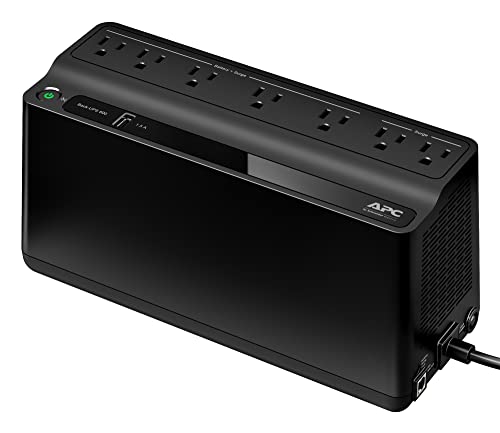
The APC BE600M1 is a practical UPS solution for homeowners and remote workers who depend on continuous internet and computer access. With 600VA capacity and 330W of usable power, it delivers 23 minutes of runtime at 100W load, which is enough time to safely shut down your system or ride out a brief power dip. The unit features 5 outlets with full battery and surge protection, plus 2 surge-only outlets for devices like printers or speakers that don't need battery backup.
What sets this model apart is its thoughtful desk design. The outlets are well-spaced to accommodate bulky power adapters, and the built-in 1.5A USB port keeps your phone charged during outages without consuming battery capacity from your computer. For homeowners dealing with frequent brownouts or brief interruptions, this combination of features provides real peace of mind without requiring a dedicated outlet strip elsewhere in your home.
Long-term value is enhanced by the user-replaceable battery cartridge (APC model APCRBC154), which means you can extend the unit's lifespan for years without buying a new UPS. The 3-year warranty and equipment protection plan add confidence that your connected devices are covered against power-related damage. This is an honest choice for protecting essential equipment on a budget.
| Specification | Details |
|---|---|
| Brand | APC |
| Model | BE600M1 |
| Capacity | 600VA / 330W |
| Battery Runtime | 23 minutes at 100W load |
| Outlets | 5 battery-backed + 2 surge-only (7 total) |
| USB Charging | 1.5A USB port (works during outage) |
| Surge Protection | All outlets protected |
| Battery Type | User-replaceable (APCRBC154) |
| Warranty | 3 years + equipment protection |
| Design | Compact, desk-friendly form factor |
Setup: Plug the UPS into a wall outlet and connect your computer, router, modem, and other critical devices to the battery-backed outlets (typically the top row). Connect less critical gear like printers to the surge-only outlets. Plug your phone charger into the USB port.
During an Outage: The UPS automatically switches to battery power, keeping your equipment running. You'll hear a beep and see indicator lights showing battery status. Use this time to save your work and properly shut down your computer. The USB port continues charging your phone throughout the outage.
Battery Replacement: When battery runtime drops noticeably (usually after 3-5 years), order the APC APCRBC154 replacement cartridge. Open the UPS case, disconnect the old battery, and plug in the new one. No tools or technical knowledge required. This extends your UPS lifespan without buying a new unit.
Load Priority: Plug your modem and router into battery-backed outlets first, then your computer. This ensures internet stays up longest, allowing you to upload work and stay connected during an outage.
Runtime Planning: At 100W load, you get 23 minutes. If you're running your computer plus router plus monitor, you're likely drawing 150-200W, which cuts runtime to 12-15 minutes. Plan your shutdown sequence accordingly.
Preventive Maintenance: Unplug the UPS and let it sit for 2-3 minutes monthly to keep the battery healthy. Avoid placing it in hot areas (above 77F) or near vents, as heat degrades battery lifespan faster.
Surge Protection Value: Even if you never experience an outage, the UPS protects against voltage spikes from everyday power fluctuations. This is especially valuable for expensive routers, NAS drives, and computer equipment.
Who Should Buy This: Remote workers, home office users, gamers with expensive setups, homeowners with frequent power dips, and anyone protecting a router or NAS drive. It's ideal if you live in an area with occasional outages or unstable power.
Who Might Need More: If you need runtime longer than 30 minutes, or if you're powering multiple computers and high-draw devices simultaneously, consider a higher-capacity model (1000VA or above). This unit is designed for single-computer setups and small networks.
Key Decision Points: Runtime is the main limitation. Calculate your typical power draw (computer + monitor + router) and confirm 23 minutes at 100W meets your needs. If you need the UPS mainly for safe shutdowns and internet continuity, this is plenty. If you need extended runtime for work continuation, you'll want more capacity.
Total Cost of Ownership: The 600VA price is low, but factor in a battery replacement (APCRBC154) every 3-5 years. This remains affordable compared to larger models, and the replaceable battery keeps costs down versus buying new each cycle.

Pros
- Ample outlet configuration handles entire home office or entertainment setups with dedicated battery and surge protection
- AVR technology stabilizes power fluctuations, extending runtime and protecting sensitive electronics like gaming PCs
- Replaceable battery design saves money over the UPS lifetime and keeps your system current
- Real-time LCD display shows battery charge, load capacity, and estimated runtime for easy monitoring
- Strong warranty and equipment protection provide peace of mind for valuable connected devices
Cons
- 68-minute runtime at full 100W load is modest for extended outages affecting multiple devices simultaneously
- Requires separate purchase of replacement battery (APCRBC124) when battery eventually degrades after 3-5 years of use
The APC BX1500M delivers substantial backup power for home offices, entertainment centers, and smart home hubs. With 1500VA capacity and 900W output, it ranks among the highest-capacity UPS systems designed for residential use. The dual-outlet configuration is particularly smart: five outlets provide battery-backed power for essentials like computers, routers, and modems, while five additional surge-only outlets handle peripherals and lower-priority devices. Built-in coaxial and Ethernet surge protection rounds out the defense against power anomalies.
The automatic voltage regulation (AVR) feature is a standout for homes experiencing frequent brownouts or voltage fluctuations. Rather than immediately draining the battery during minor power irregularities, AVR corrects low voltage and surges automatically, preserving runtime for actual blackouts. This approach also benefits active PFC power supplies found in modern gaming PCs and workstations. At a 100W load (typical for a computer setup), the unit provides approximately 68 minutes of backup time, which is reasonable for gracefully shutting down systems or riding out brief outages.
Long-term value is enhanced by the user-replaceable battery design and ENERGY STAR certification. Unlike many UPS units that require professional service when the battery ages, the BX1500M lets homeowners swap the battery independently, avoiding downtime and service fees. The 3-year warranty and $75,000 equipment protection policy reflect APC's confidence in the unit's durability and provide meaningful coverage for expensive connected devices. The LCD display keeps you informed with real-time monitoring of battery status and runtime estimates.
| Specification | Details |
|---|---|
| Brand | APC |
| Model | BX1500M |
| VA Rating | 1500VA |
| Wattage | 900W |
| Battery Backup Outlets | 5 |
| Surge-Only Outlets | 5 |
| Backup Runtime (100W) | Up to 68 minutes |
| Automatic Voltage Regulation | Yes (88V+ and +/-13%) |
| Coaxial Protection | Yes |
| Ethernet Protection | Yes |
| Battery Type | User-replaceable (APCRBC124) |
| Display | LCD with real-time monitoring |
| Energy Efficiency | ENERGY STAR certified (92%+) |
| Warranty | 3 years |
| Equipment Protection | $75,000 |
| Active PFC Compatible | Yes |
Initial Setup: Unpack the unit and place it on a flat, well-ventilated surface near your equipment. Plug the UPS into a wall outlet and allow the battery to fully charge before connecting your devices (typically 4-8 hours for first charge).
Connecting Devices: Plug essential devices (computer, modem, router, external drives) into the five battery backup outlets (usually marked). Connect non-critical devices like monitors and printers to the five surge-only outlets. The unit will automatically switch to battery power during an outage.
Monitoring Status: Check the LCD display regularly to see battery charge level and current load percentage. During normal operation, the display shows input voltage and load capacity. When an outage occurs, it displays estimated runtime remaining so you can prioritize shutdowns.
Battery Maintenance: Keep the unit plugged in during normal operation so the battery stays charged. Most UPS batteries last 3-5 years; when runtime drops noticeably, order the replacement battery (APCRBC124) and follow the simple swap procedure in your manual.
Is This the Right UPS for You? The BX1500M suits homeowners with home offices, small server setups, entertainment systems, or smart home hubs. If you work remotely and need your computer, router, and external storage protected during outages, this unit is well-matched. It's also ideal for protecting valuable electronics like gaming PCs, NAS systems, and home theater equipment from power surges and voltage swings.
Capacity Considerations: With 900W output, this unit can support multiple devices simultaneously, but not a full household. A typical computer setup (tower + monitor + peripherals) draws 200-400W, leaving headroom for routers, modems, and other smart devices. If you need to protect high-power devices like refrigerators or HVAC systems, you'll need a larger, commercial-grade UPS.
Runtime Expectations: The 68-minute runtime at 100W is sufficient for most home office scenarios: shutting down a computer gracefully, running a router through a brief outage, or keeping security cameras and smart home hubs online. For extended blackouts, prioritize which devices stay powered and which you'll shut down first.
Warranty and Support: The 3-year warranty and $75,000 equipment protection provide strong coverage. Keep your receipt and register the product with APC to activate the full warranty benefits. The user-replaceable battery is a major advantage for long-term ownership, as it eliminates expensive service calls.
Optimize Your Outlet Layout: Reserve the five battery backup outlets for your most critical devices: computer, modem, router, and external drives. Plug lower-priority items like desk lamps, phone chargers, and monitors into the surge-only outlets. This maximizes runtime for devices that truly need uninterrupted power.
Leverage AVR for Voltage Stability: The automatic voltage regulation corrects minor power fluctuations without draining your battery. This is especially valuable in areas prone to brownouts or unstable grid voltage. Your devices stay protected, and your battery lasts longer for actual blackouts.
Plan Your Load: Calculate the wattage of devices you'll run simultaneously during an outage. A typical setup (computer tower 300W + router 20W + modem 15W + external drive 10W) totals about 345W, leaving you well under the 900W limit and providing extended runtime.
Test Your Setup: Once installed, periodically disconnect the unit from the wall outlet for 10-15 seconds to confirm everything switches to battery power smoothly. This ensures your devices are truly protected and gives you confidence in the system before a real outage occurs.
Battery Replacement Timing: Most users replace the battery every 3-5 years depending on usage patterns and climate. Mark your calendar when you first install the unit so you're not caught off guard. Keeping a spare battery on hand eliminates downtime if replacement becomes urgent.

Pros
- Pure sine wave technology is safer for sensitive equipment than standard simulated wave UPS units
- Generous outlet configuration with both battery-backed and surge-only options covers multiple devices
- AVR feature protects against chronic voltage problems without unnecessary battery drain
- Replaceable battery design saves money and reduces waste compared to throw-away models
- LCD interface provides clear visibility into runtime and load without confusing indicators
Cons
- 900W capacity may struggle with high-demand systems running multiple power-hungry components simultaneously
- At 1500VA, this unit is moderately sized and heavier than compact UPS models, requiring dedicated shelf space
The APC BR1500MS2 stands out as a serious UPS option for homeowners and professionals who depend on their computer systems staying online. Its pure sine wave output is a critical advantage over budget UPS models that use simulated sine waves, which can cause damage to modern electronics like NAS drives, gaming PCs, and high-end monitors over time. With 1500VA/900W of capacity and up to 73 minutes of runtime at minimal load, this unit gives you enough time to safely shut down your system, save active work, or ride out brief power interruptions entirely.
What makes this APC model particularly practical is its intelligent power management. The Automatic Voltage Regulation (AVR) feature continuously monitors your incoming power and corrects voltage fluctuations without triggering battery backup, which means it protects your equipment from the slow damage caused by brownouts and spikes while preserving battery life for actual outages. The 10-outlet configuration is thoughtfully designed with 6 battery-backed outlets for your essential devices (PC, monitor, router, NAS) and 4 surge-only outlets for peripherals, plus dedicated coax and Ethernet protection that many users overlook but desperately need.
The user-replaceable battery is a genuine long-term value proposition, allowing you to extend the unit's life for under $100 when battery capacity eventually degrades after several years. The angled LCD display keeps you informed with real-time data on remaining runtime and current load draw, and the silenceable alarm respects your workspace. Backed by a 3-year warranty, this APC delivers the reliability and feature set expected from the brand's reputation in power protection.
| Specification | Detail |
|---|---|
| Model | BR1500MS2 |
| Capacity | 1500VA / 900W |
| Waveform Output | Pure Sine Wave |
| Runtime at 100W | Up to 73 minutes |
| Battery Type | User-replaceable (APCRBC163) |
| Total Outlets | 10 (6 battery-backed, 4 surge-only) |
| Additional Protection | Coax and Ethernet surge protection |
| Voltage Regulation | Automatic Voltage Regulation (AVR) |
| Power Factor Compatible | Active PFC compatible |
| Front Ports | USB-C and USB-A charging |
| Display | LCD with runtime, load, and battery health |
| Warranty | 3 years |
Is This UPS Right for You? The BR1500MS2 works best for home office setups, gaming PCs, small server rooms, or creative workstations where you have multiple devices that need protection. If you're running a single laptop or light computing load, a smaller 650VA or 1000VA unit may suffice. However, if you have a desktop PC, monitor, NAS drive, router, and peripherals all drawing power, this 1500VA capacity provides comfortable headroom.
Pure Sine Wave vs. Simulated Wave Don't overlook the pure sine wave specification. Modern power supplies with Active Power Factor Correction (PFC) and sensitive devices like NAS drives, printers, and audio equipment can be damaged by the simulated sine waves produced by cheaper UPS units. Pure sine wave output ensures clean, stable power that matches your wall outlet quality.
Runtime Expectations At full 900W load, runtime will be significantly shorter than the 73-minute figure (which applies at 100W). Plan on 15-25 minutes at typical office load (300-500W). This is enough to safely save your work and shut down gracefully, not to power your entire setup for hours. If you need extended runtime, consider pairing this with a larger battery pack or stepping up to a higher capacity model.
Maintenance and Battery Replacement The user-replaceable battery is a major advantage. When battery capacity degrades after 3-5 years, you can swap in a new APCRBC163 battery for around $80-120 instead of replacing the entire unit. Keep the UPS in a cool, dry location and avoid constant high-load operation to extend battery lifespan.
Outlet Strategy Assign your 6 battery-backed outlets strategically: PC tower, monitor, router, and NAS get priority. Use the 4 surge-only outlets for printers, speakers, or desk lamps that don't need battery backup. This maximizes your runtime by avoiding unnecessary drain from non-critical devices.
Voltage Regulation Benefit The AVR feature is your silent protector. In areas with chronic power quality issues (voltage sags or spikes), leave this unit powered on 24/7 even when your PC is off. It will silently regulate incoming power and extend the lifespan of all connected electronics, including your router and NAS.
Monitor the LCD Display Check the load percentage displayed on the LCD regularly. If you're consistently running above 80% of capacity during normal operation, you're pushing the limits and should consider upgrading. This helps you plan for future expansion before you hit the ceiling.
Test Your Setup Once installed, manually trigger a brief battery test by flipping the power switch or unplugging the unit for 10 seconds to confirm all your critical devices are properly connected and functioning on battery power. Don't wait for a real outage to discover a problem.

Pros
- Ample outlet count (10 total) accommodates most home office and gaming setups
- AVR technology handles minor voltage fluctuations automatically, extending battery life
- User-replaceable battery design keeps the UPS functional long-term at lower cost
- Comprehensive protection includes Ethernet and phone line surge suppression
- Detailed LCD display helps you monitor power conditions and plan backup needs
Cons
- 810W capacity limits simultaneous use of high-draw devices like space heaters or large monitors
- No mention of remote management or network monitoring software for advanced users
The Tripp Lite OMNI1500LCDT delivers solid, practical protection for home offices, gaming rigs, and small network setups. With 810W of battery backup capacity and 10 outlets, it handles the essentials: computers, monitors, routers, and peripherals. The automatic voltage regulation (AVR) is particularly useful for homes with spotty power quality, silently correcting brownouts and overvoltages without draining the battery, which extends how long you can actually use the system when the power goes out.
What stands out is the user-replaceable battery design. Rather than being stuck with an expensive service call or a dead UPS after a few years, you can swap in a new RBC51 battery cartridge yourself. The 650 joules of surge protection, combined with Ethernet and phone line protection, covers the full spectrum of modern home office threats. The LCD screen gives you real-time visibility into runtime, load, and system status, which is helpful for understanding your setup's power needs and planning accordingly.
The 3-year warranty and $250,000 equipment insurance provide legitimate peace of mind, and Eaton's technical support team is accessible if problems arise. The main limitation is that 810W isn't enough for power-hungry devices, so you'll need to be selective about what you plug in during an outage. For most home office and gaming scenarios, however, this UPS strikes a practical balance between capacity, features, and long-term value.
| Capacity | 1500VA / 810W |
|---|---|
| Outlets | 10 total (backup + surge protected) |
| Surge Protection | 650 joules |
| Voltage Regulation | Automatic (AVR) 92V-150V to 120V |
| Additional Protection | Ethernet RJ45 and Telephone/DSL RJ11 |
| Battery Type | User-replaceable RBC51 cartridge |
| Display | LCD screen (runtime, wattage, voltage, status) |
| Cord Length | 6-foot extension (NEMA 5-15P) |
| Warranty | 3-year limited manufacturer's warranty |
| Insurance | $250,000 equipment protection |
Who Should Buy This? The OMNI1500LCDT is ideal for home office workers, gamers, and small business owners who need reliable backup power and surge protection. It's also a smart choice if you have networking equipment (router, modem, NAS) that you want to keep online during outages.
Capacity Considerations: With 810W of backup power, you can typically run a desktop computer, monitor, and router simultaneously. High-draw devices like laser printers, space heaters, or multiple large monitors will drain the battery faster or exceed capacity. Calculate your typical load before purchasing.
Installation Tips: Place the UPS in a well-ventilated location away from direct sunlight and moisture. Use the 10 outlets strategically: plug essential devices (computer, monitor, router) into UPS-backed outlets, and less critical items (desk lamp, chargers) into surge-only outlets. Keep the battery cartridge accessible in case you need to replace it down the road.
Maintenance: Periodically check the LCD display to confirm the unit is functioning normally. Test the battery backup quarterly by unplugging the UPS from the wall to ensure it activates properly. Replace the battery cartridge when the runtime drops significantly (typically every 3-5 years depending on use and local power quality).
Overload Protection: The UPS will alert you via the LCD display if the connected load exceeds 810W. Never ignore this warning, as it reduces runtime and stresses the battery. Unplug non-essential devices if you see an overload indicator.
Ventilation: Ensure the UPS has at least 2-3 inches of clearance on all sides for proper airflow. Blocked vents can cause overheating, especially during extended battery operation.
Power Cord Safety: Use the included 6-foot extension cord or a quality replacement. Never daisy-chain multiple power strips with the UPS, as this defeats surge protection and creates fire hazards. Plug the UPS directly into a wall outlet.
Battery Handling: When replacing the RBC51 battery cartridge, ensure the UPS is unplugged from the wall outlet first. Follow the manufacturer's instructions carefully, and dispose of old batteries according to local regulations (many retailers accept old UPS batteries for recycling).
Moisture and Heat: Keep the UPS away from water sources, humidity, and direct sunlight. High temperatures reduce battery lifespan, so avoid placing it near radiators, vents, or other heat sources.
Maximize Runtime: During a power outage, disable non-essential programs and devices to reduce power draw. Close background applications, turn off external monitors if possible, and use battery saver mode on your computer. This simple step can double or triple how long your system stays online.
Monitor Power Quality: The LCD display shows input voltage in real time. If you frequently see readings below 110V or above 130V, your home has poor power quality. The AVR will handle minor fluctuations, but consider a whole-home surge protector or voltage regulator for additional protection.
Plan Your Outlet Usage: Not all 10 outlets provide battery backup; some are surge-only. Read the manual to identify which outlets are UPS-backed, and reserve those for your most critical devices (computer, monitor, router). Use surge-only outlets for less critical equipment.
Test Before You Need It: Once monthly, unplug the UPS from the wall to confirm the battery activates and powers your devices. This ensures you'll have working backup when a real outage occurs. Note how long the battery actually lasts under your typical load so you know what to expect.
Document Your Setup: Take a photo of your UPS configuration showing which devices are plugged in and which outlets they use. This reference helps you quickly restore power after an outage and assists technicians if you ever need support.
Pros
- Pure sinewave technology is safer for computers, networking equipment, and sensitive devices than simulated sine waves
- AVR feature reduces unnecessary battery drain by stabilizing minor voltage fluctuations without switching to battery mode
- Generous outlet configuration separates battery-backed devices from surge-only outlets for flexible power management
- Color LCD display with tilt function makes monitoring easy from various angles and distances
- Included management software allows monitoring and control from your computer or network
Cons
- 1000W continuous power output may limit the number of high-demand devices that can run simultaneously on battery
- Battery runtime is moderate for extended outages, typically providing 10-20 minutes of full-load backup depending on connected devices
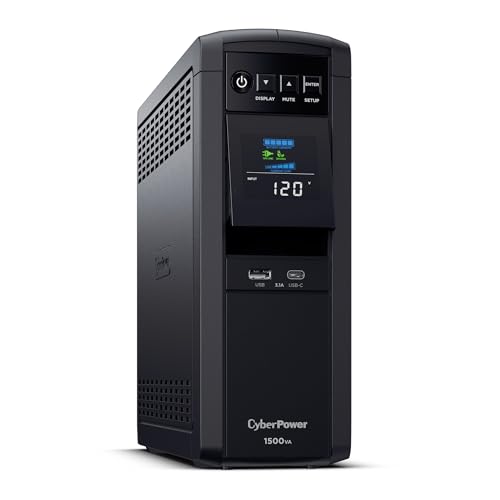
The CyberPower CP1500PFCLCD delivers reliable power protection for home offices, small networks, and entertainment systems. With 1500VA capacity and pure sinewave output, it safely powers computers, routers, modems, and other sensitive equipment without the harmonic distortion that can damage electronics over time. The 12-outlet configuration smartly separates six battery-backed outlets from six surge-protected outlets, letting you prioritize which devices matter most during an outage.
What sets this UPS apart is its automatic voltage regulation (AVR) feature, which corrects minor power fluctuations without draining the battery. This extends battery life significantly compared to units that switch to battery mode for every voltage dip. The color LCD display provides immediate visibility into power status, battery charge level, load percentage, and estimated runtime, with a tilt function that makes reading the screen easy from different angles. The included dual USB ports add practical value for charging phones and tablets without occupying outlet space.
The 3-year warranty covering the battery and the $500,000 connected equipment guarantee reflect CyberPower's confidence in this unit's protection capabilities. Free PowerPanel management software enables remote monitoring, scheduled shutdowns, and notifications on your computer. For homeowners and small business operators seeking dependable backup power with smart monitoring features, this model strikes a solid balance between capacity, safety, and usability.
| Specification | Details |
|---|---|
| Capacity | 1500VA / 1000W (continuous) |
| Output Waveform | Pure Sinewave |
| Topology | Line-Interactive |
| Total Outlets | 12 NEMA 5-15R outlets |
| Battery-Backed Outlets | 6 outlets with surge protection |
| Surge-Only Outlets | 6 outlets |
| Input Connection | NEMA 5-15P right angle plug, 45-degree offset, 5-foot cord |
| USB Ports | 2 ports (1 Type-A, 1 Type-C) for device charging |
| Display | Multifunction color LCD, tilts up to 22 degrees |
| Voltage Regulation | Automatic Voltage Regulation (AVR) |
| Form Factor | Mini Tower |
| Warranty | 3 years, including battery |
| Equipment Guarantee | $500,000 Connected Equipment Guarantee |
| Software | Free PowerPanel Management Software |
| Certification | UL Certified |
Who Should Buy This UPS? Home office workers, small business operators, gamers, and anyone with sensitive electronics that need protection from power loss and surges. It's especially valuable if you have multiple devices that must stay powered during outages (computers, routers, modems, external drives, monitors).
Key Considerations Before Purchase: Evaluate your power needs by adding the wattage of devices you want to run during an outage. The 1000W continuous rating means you can't run everything simultaneously, but you can choose which devices get battery power via the outlet configuration. Consider how long you need backup power; this unit typically provides 10-20 minutes of runtime depending on load, which is sufficient for saving work and shutting down gracefully, but not for extended outages.
Setup and Installation: Place the UPS in a well-ventilated location near your equipment. Plug it into a standard wall outlet, then connect your devices to the appropriate outlets based on priority. Install the free PowerPanel software to monitor status and receive alerts on your computer. Perform a test by briefly unplugging the UPS to verify battery operation before relying on it.
Placement and Ventilation: Keep the UPS on a flat, stable surface with at least 4 inches of clearance on all sides for proper air circulation. Never cover vents or place it in enclosed spaces. Keep it away from moisture, extreme heat, and direct sunlight.
Load Management: Do not exceed the 1000W continuous power rating. Overloading reduces battery runtime and can trigger automatic shutdown to protect equipment. Use the battery-backed outlets only for essential devices like computers, routers, and modems.
Battery Safety: The internal battery contains lead-acid chemistry and should never be opened or modified. If the unit emits unusual odors or sounds, immediately unplug it and contact support. Dispose of the battery according to local regulations when replacement is needed. Keep the unit away from children and pets.
Maintenance: Perform a battery test monthly by briefly unplugging the UPS to ensure the battery functions properly. Clean dust from vents regularly using a soft cloth. Do not use water or liquid cleaners on the unit.
Optimize Your Outlet Configuration: Assign battery-backed outlets to devices in this priority order: computer/workstation, router/modem, external hard drive or NAS. Assign surge-only outlets to printers, monitors, and peripheral devices that don't need backup power. This maximizes runtime and ensures you can save work and shut down gracefully.
Use AVR to Extend Battery Life: The automatic voltage regulation feature handles minor power fluctuations (brownouts and sags) without draining the battery. This means your battery stays fresher longer, making it more reliable when you actually need it during a true power outage.
Leverage PowerPanel Software: Install the free management software to set up automatic shutdown of your computer when battery reaches a certain level. This prevents data loss and ensures graceful shutdown during extended outages. You can also receive email or SMS alerts if you configure network connectivity.
Perform Regular Battery Tests: Test the battery monthly by briefly unplugging the UPS or using the software's test feature. This ensures the battery remains healthy and ready for actual use. Battery capacity degrades over time, so knowing its condition helps you plan for replacement.

Pros
- Affordable entry-level UPS that protects home office and entertainment equipment without premium pricing
- Four dedicated battery backup outlets ensure critical devices stay online during power loss
- Compact footprint doesn't dominate desk or shelf space, making it practical for any home setup
- Excellent warranty coverage including the battery itself, showing manufacturer confidence in durability
- Surge protection on all 8 outlets safeguards against electrical spikes and voltage fluctuations
Cons
- Simulated sine wave output may not be suitable for sensitive electronics like high-end audio equipment or medical devices
- 260W capacity limits the number and type of devices you can run simultaneously during an outage
The CyberPower ST425 delivers straightforward, dependable backup power for the typical American home office or entertainment setup. With 425VA of capacity and 260W of usable power, this standby UPS keeps your internet router, computer, and monitor running long enough to save your work and shut down gracefully when the power goes out. The eight outlets split evenly between four battery-backed and four surge-only sockets, giving you flexibility in how you prioritize your devices.
What makes this model stand out for budget-conscious homeowners is its combination of practical features and solid warranty coverage. The GreenPower efficiency design minimizes energy consumption, which means lower electricity bills over time. The transformer-spaced outlets prevent bulky power adapters from blocking adjacent sockets, and the compact dimensions mean it won't dominate your workspace. The 3-year warranty, which unusually includes the battery, demonstrates CyberPower's confidence in this unit's longevity.
Keep in mind that the ST425 uses simulated sine wave technology rather than pure sine wave output, which is perfectly fine for computers and standard office equipment but may not suit sensitive electronics like premium audio systems. Additionally, the 260W capacity means you'll need to be selective about which devices you plug into the battery-backed outlets during an extended outage. For most home offices and casual gaming setups, these trade-offs represent excellent value.
| Specification | Detail |
|---|---|
| Model | CyberPower ST425 |
| Capacity | 425VA / 260W |
| Output Type | Simulated Sine Wave |
| Total Outlets | 8 NEMA 5-15R |
| Battery Backup Outlets | 4 outlets |
| Surge-Only Outlets | 4 outlets |
| Input Connector | NEMA 5-15P (right angle, 45-degree offset) |
| Power Cord Length | 5 feet |
| Design Feature | Transformer-spaced outlets |
| Efficiency Technology | GreenPower high efficiency |
| Warranty | 3 years (includes battery) |
| Equipment Guarantee | $75,000 USD connected equipment protection |
| Safety Certification | UL certified |
| Status Indicators | LED power-on and wiring fault lights |
Who Should Buy This UPS? The ST425 is ideal for homeowners with home offices, online gamers, and anyone who wants to protect their internet connectivity and computers from unexpected power loss. It's particularly suited for people in areas with occasional brownouts or brief outages.
What Devices Work Best? Plug computers, monitors, routers, modems, and gaming consoles into the battery-backed outlets. Reserve the surge-only outlets for printers, desk lamps, and other non-critical devices. Avoid connecting sensitive audio equipment, medical devices, or equipment requiring pure sine wave power.
Sizing Your Needs: The 260W capacity typically supports a computer setup (monitor, tower, peripherals) or a gaming console with a router for 15-30 minutes, depending on your exact equipment. Calculate your wattage needs by checking the power labels on your devices; if your total exceeds 260W, you'll need a larger UPS.
Installation Tips: Place the UPS on a stable, well-ventilated surface away from direct heat sources. Keep the 5-foot power cord accessible to a wall outlet. Test the battery backup monthly by unplugging the unit to ensure it's functioning properly. The LED indicators will help you spot any wiring issues immediately.
Proper Usage: Never overload the UPS beyond its 260W capacity. Check the wattage of all connected devices and add them together to stay within limits. Overloading can damage the battery and reduce its lifespan.
Ventilation: Ensure at least 2-3 inches of clear space around the unit for air circulation. Do not place the UPS in a confined cabinet or cover it with blankets or papers, as it generates heat during operation and battery charging.
Electrical Safety: The UPS protects your equipment from surges, but it is not a replacement for a whole-home surge protector. Use it in conjunction with a quality power strip or home electrical surge protection for comprehensive defense. Never use this UPS in wet or damp environments.
Battery Maintenance: Keep the unit plugged in when not in use so the battery stays charged. Most UPS batteries last 3-5 years; if backup time drops significantly, the battery may need replacement. The 3-year warranty covers this, so contact CyberPower if performance declines.
Emergency Shutdown: During a power outage, use the battery backup time to save your work and shut down your computer properly. Do not rely on the UPS to keep your system running indefinitely. Always have a plan to gracefully power down before the battery depletes.

Pros
- Plenty of outlets and USB ports eliminate the need for multiple power strips in your office
- Battery is replaceable without professional help, extending the UPS lifespan affordably
- Strong runtime at moderate loads gives you time to save work or safely shut down systems
- Compact footprint fits under desks or beside equipment without taking up much space
- Quiet operation with silenceable alarm won't disrupt your workday during brief outages
Cons
- 35-minute runtime is adequate for shutdowns but limited for extended outages affecting entire neighborhoods
- LED display lacks detail compared to networked UPS models that integrate with smart home systems
The APC BE850G2 is a solid mid-range UPS designed specifically for home offices and small business setups. With 850VA of capacity and 450W of usable power, it delivers up to 35 minutes of runtime at 100W loads, giving you enough time to save documents, back up data, or execute a graceful shutdown before your equipment goes dark. This is critical for anyone running a desktop PC, NAS, router, and modem simultaneously, where an unexpected power cut can mean lost work and corrupted files.
The outlet configuration is thoughtfully designed for real-world home office needs. Six battery-backed outlets handle your essential gear (computer, monitor, router, modem, NAS), while three surge-only outlets protect peripherals like printers and external drives without draining battery capacity. The addition of two USB-A charging ports means your phone and tablet stay powered without sacrificing an outlet, a convenience that adds genuine value in a busy workspace. The user-replaceable battery is a major advantage, letting you extend the UPS lifespan by simply swapping in a new RBC17 battery when the time comes, without calling a technician.
Setup and monitoring are straightforward. LED indicators show power status instantly, and the alarm is silenceable so it won't startle you during a brief flicker. The 3-year warranty plus equipment protection coverage provides meaningful peace of mind for homeowners investing in power stability. This UPS won't handle multi-hour outages or power an entire home, but for protecting a focused workspace and preventing data loss, it delivers reliable performance at a reasonable price point.
| Specification | Detail |
|---|---|
| Model | APC BE850G2 |
| Capacity | 850VA / 450W |
| Battery Runtime | 35 minutes at 100W load |
| Battery-Backed Outlets | 6 NEMA outlets |
| Surge-Only Outlets | 3 NEMA outlets |
| USB Charging Ports | 2 USB-A ports (5V/2.4A shared) |
| Total Outlets | 9 outlets + 2 USB ports |
| Warranty | 3 years + equipment protection |
| Battery Type | User-replaceable (RBC17 sold separately) |
| Indicators | LED status lights, silenceable alarm |
| Supported Devices | Desktops, routers, modems, NAS, monitors, smart home gear |
Is This UPS Right for You? The BE850G2 is ideal for home office workers, small business owners, and DIYers who want to protect computers, routers, and network storage from power outages. If your workspace includes a desktop, monitor, router, modem, and NAS, this UPS has the outlets and capacity to cover all of them.
Who Should Look Elsewhere? If you need to power your entire home during extended outages, or if you're running high-wattage equipment like space heaters or air compressors, you'll need a larger generator or whole-home backup system. This UPS is designed for office equipment and network devices, not high-power loads.
Key Considerations Think about which devices are truly essential during an outage. Battery-back your computer, router, and modem first, then add your NAS or other storage if you have room. Use surge-only outlets for peripherals that don't need battery runtime. Check your total wattage draw to ensure you stay within the 450W limit for maximum runtime. The 35-minute window is perfect for saving work and shutting down safely, but not for riding out hours-long outages.
Maximize Your Runtime The 35-minute runtime assumes a 100W load. If you connect fewer devices or use lower-power equipment, you'll get significantly longer runtime. Conversely, heavier loads will reduce runtime. Know your equipment's wattage to plan accordingly.
Battery Maintenance Keep the UPS plugged in at all times so the battery stays charged and ready. Most UPS batteries last 3-5 years before needing replacement. Mark your calendar when you install it so you remember to order the RBC17 replacement battery before it fails.
Outlet Strategy Reserve your six battery-backed outlets for devices that absolutely need to stay on: computer, router, modem, and NAS. Plug printers, external hard drives, and monitors into the three surge-only outlets. This preserves battery power for the equipment that matters most.
Placement and Ventilation Position the UPS where air can circulate freely around it. Don't block the vents with cables or place it in a closet. Good airflow keeps the battery and electronics cool, extending their lifespan and ensuring reliable performance when you need it.

Pros
- Excellent outlet configuration balances battery-backed and surge-only protection for flexible device placement
- ECO mode genuinely lowers electricity bills by eliminating phantom power drain from sleeping peripherals
- Simulated sine wave output safely powers sensitive electronics like modems and networking equipment
- Comprehensive warranty and equipment guarantee demonstrate manufacturer confidence in reliability
- LCD panel eliminates guesswork about battery health and remaining runtime
Cons
- Simulated sine wave output may cause minor interference with some high-end audio equipment or medical devices
- Battery runtime is modest at 510W actual power, so runtime during full-load outages will be 10-20 minutes depending on what's plugged in
The CyberPower EC850LCD strikes a practical balance between capacity, outlet count, and price for homeowners protecting home offices and entertainment systems. With 12 NEMA outlets split between battery-backed and surge-only protection, you get flexibility to prioritize which devices stay powered during outages while others receive surge protection only. The 850VA rating handles typical home setups including computers, monitors, routers, modems, and streaming devices without breaking a sweat.
What truly sets this UPS apart is the ECO mode feature, which automatically cuts power to designated outlets when it detects your computer has powered down or entered sleep mode. This isn't just a convenience feature, it meaningfully reduces energy consumption and lowers your monthly electricity bill by eliminating the constant drain from peripherals that don't need to stay powered. Combined with the detailed LCD display showing real-time battery status and power conditions, you get genuine insight into your system's health and performance.
The 3-year warranty covering the battery plus the $100,000 connected equipment guarantee reflects solid manufacturer backing. Runtime during an outage will depend on your load, but expect 10-20 minutes of operation at typical home office power levels, which provides enough time to save work and shut down gracefully or switch to a generator. The compact footprint makes it easy to position under a desk or beside entertainment equipment without dominating your space.
| Specification | Detail |
|---|---|
| Capacity | 850VA / 510W |
| Output Waveform | Simulated Sine Wave |
| Total Outlets | 12 NEMA 5-15R |
| Battery-Backed Outlets | 6 outlets with surge protection |
| Surge-Only Outlets | 6 outlets (3 with ECO mode control) |
| Input Connector | NEMA 5-15P right angle, 45-degree offset |
| Power Cord Length | 5 feet |
| Display | Multifunction LCD panel |
| ECO Mode | Yes, automatically reduces power to peripherals |
| Warranty | 3 years including battery |
| Equipment Guarantee | $100,000 Connected Equipment Protection |
| Software | PowerPanel Personal Edition (free download) |
| UL Certification | Yes |
Is this UPS right for you? The EC850LCD works best for home offices, small business setups, and entertainment centers where you need to protect multiple devices but don't have the budget for high-end pure sine wave systems. It's ideal if you want automatic power-saving features and real-time monitoring without complexity.
What should you plug in where? Connect your computer, monitor, and router to the battery-backed outlets so they stay powered during outages. Use the ECO-controlled outlets for peripherals like printers and speakers that can safely power down. Reserve regular surge-only outlets for devices that don't need backup power, like lamps or phone chargers.
Runtime expectations: At typical home office loads (300-400W), expect 15-20 minutes of battery runtime. At full capacity (510W), runtime drops to 10-15 minutes. This is enough to save work and shut down gracefully, not enough to run your entire setup for hours. If you need longer runtime, consider a larger capacity model or add a backup generator.
Maintenance tips: Test the battery quarterly by unplugging the UPS from wall power and confirming battery outlets light up. Replace the battery after 3-5 years of normal use. Keep the unit in a cool, dry location away from direct sunlight and heat sources to maximize battery lifespan.
Maximize ECO mode savings: Assign all peripherals that don't need continuous power to ECO-controlled outlets. Printers, external hard drives, speakers, and desk lamps are perfect candidates. You'll see measurable savings on your electric bill over time, especially if these devices stay powered 24/7 in sleep mode.
Optimize outlet assignment: Put your internet equipment (modem and router) on battery-backed outlets first. These devices are critical for staying connected during an outage. Your computer monitor can share battery power since it draws less than the CPU. Save surge-only outlets for peripherals that are nice to have but not essential during an outage.
Use the management software: Download PowerPanel Personal Edition to monitor battery health, set automatic shutdown schedules, and receive alerts if power conditions change. This is especially useful if your UPS is in a closet or less visible location. You'll get real-time notifications on your computer instead of checking the LCD manually.
Plan for battery replacement: Mark your calendar for year 3 when the battery will likely need replacement. A fresh battery costs less than a new UPS and keeps your investment protected. Don't wait until the battery fails to order a replacement, as you'll be without protection during the replacement process.
UPS Buying Guide: What to Look for Before You Buy
Not every UPS is built the same, and choosing the wrong one means either overspending on capacity you never use or, worse, watching your equipment shut down in the middle of a storm because the unit could not handle the load. The sections below break down the six factors that matter most when selecting an uninterruptible power supply for home or home-office use.
VA Rating and Wattage: Match the Load Before You Buy
Volt-amperes (VA) and watts are both printed on every UPS, and both numbers matter. VA describes the apparent power the unit can supply; watts describe the real power it can deliver continuously. Most UPS units convert at a power factor between 0.6 and 0.7, meaning a 1500VA model typically delivers around 900 to 1000 actual watts. Add up the wattage of every device you plan to protect, then choose a UPS rated for at least 20 percent more than that total. Undersizing is the single most common UPS buying mistake. If you also rely on a portable power station for heavier appliances during longer outages, the UPS handles short-term bridging while the station covers extended backup needs.
Pure Sine Wave vs. Simulated Sine Wave
This distinction matters more than most people realize. A simulated (or stepped approximation) sine wave output works fine for basic computers, monitors, and routers. However, active PFC power supplies, which are standard in modern gaming PCs and workstations, can behave erratically or even shut down when fed a simulated sine wave. Any UPS labeled “PFC sinewave” or “pure sine wave” produces clean, utility-grade AC power that is safe for every device. The CyberPower CP1500PFCLCD (ASIN B00429N19W) and the APC BR1500MS2 (ASIN B08GRY1W93) both deliver pure sine wave output, making them the right picks for gaming rigs and high-end workstations. If your setup runs a more modest configuration, a simulated sine wave model at a lower price point will serve you well.
Battery Runtime: How Long Do You Actually Need?
Most residential outages resolve within 15 minutes. That means a UPS providing 20 to 30 minutes of runtime at a moderate load covers the vast majority of real-world events. If you need longer protection, such as keeping a home server or NAS running through extended outages, look for models with external battery connector ports so you can add capacity over time. Runtime drops sharply as load increases, so the specs you see on the box assume a relatively light draw. Cross-reference the manufacturer’s runtime chart against your actual wattage. Homeowners who want protection against flooding during outages should also consider battery backup sump pumps, which operate independently of a standard UPS.
Outlets: Battery-Backed vs. Surge-Only
Every UPS divides its outlets into two groups. Battery-backed outlets keep your critical devices running during an outage; surge-only outlets handle peripherals like lamps, printers, and phone chargers that do not need to stay on but should still be shielded from voltage spikes. Count how many devices genuinely need battery support, then make sure the UPS you choose has enough battery-backed outlets to cover them. The APC BE600M1 (ASIN B01FWAZEIU) provides two battery-backed outlets alongside five surge-only outlets, which is adequate for a router, modem, and a compact NAS. The APC BX1500M (ASIN B06VY6FXMM) steps that up to 10 outlets total, with five battery-backed, covering a full home-office setup.
Automatic Voltage Regulation (AVR)
Outages get the headlines, but under-voltage (brownouts) and over-voltage conditions happen far more often and do longer-term damage to electronics. Automatic voltage regulation corrects these fluctuations without switching to battery, which extends battery life and protects sensitive components. Look for AVR on any UPS intended for areas with inconsistent grid power. Nearly every model above entry level in our lineup includes AVR, including the Eaton Tripp Lite OMNI1500LCDT (ASIN B00AX9Z7R4) and the APC BX1500M. If you live somewhere prone to brownouts, AVR should be on your non-negotiable list, the same way carbon monoxide detectors and radon detectors belong in every home regardless of perceived risk.
LCD Display and Software Connectivity
An LCD panel showing input voltage, output load, and estimated runtime turns a black box into an informative piece of equipment. Models with USB or serial ports pair with power management software that can automatically save open files and shut down your computer gracefully when the battery drops below a set threshold. This feature is particularly valuable for NAS devices and home servers. Both the CyberPower CP1500PFCLCD and the Eaton Tripp Lite OMNI1500LCDT include LCD panels and USB data ports for software integration. If your home is growing into a full smart home ecosystem, pairing a UPS with smart plugs and smart displays lets you monitor power draw and UPS status remotely.
Form Factor: Tower vs. Compact
UPS units come in several physical shapes. Mini-tower and standard tower models are the most common for home use and live comfortably under a desk. Compact or desktop models like the CyberPower EC850LCD (ASIN B00DBAA696) and the CyberPower ST425 (ASIN B07GZR981Y) take up less floor space and fit neatly in a home-office corner or on a shelf near your networking gear. Rack-mount form factors are reserved for server rooms. For most homeowners, a compact or mini-tower model is the right call, and vertical footprint rarely becomes a constraint at home. If conserving energy is a priority across your entire setup, the CyberPower EC850LCD includes an ECO mode that cuts power to idle surge-only outlets, reducing phantom load from peripherals.
Why Trust HomeThru
HomeThru is an independent review site. We do not sell products, fulfill orders, or handle returns. Our editorial team researched and analyzed dozens of uninterruptible power supplies by reviewing technical specifications, manufacturer documentation, verified buyer feedback across thousands of reviews, and hands-on assessments from established electrical and tech publications. We apply the same research-driven approach across all of our safety and appliance coverage, from portable generators ranked for home backup to battery backup sump pumps evaluated for flood protection reliability. Every recommendation reflects what we would actually put in our own homes, not what earns the highest commission.
Final Thoughts
After evaluating all eight models in this lineup across capacity, output quality, runtime, and value, here is how we award the top honors:
- Best Overall: APC BX1500M delivers 1500VA of reliable backup for home offices, with AVR, 10 outlets, and an informative LCD at a mid-range price point that covers most home-office configurations without over-engineering the setup.
- Best for Gaming PCs and Workstations: APC BR1500MS2 provides pure sine wave output and USB-C charging alongside robust AVR, making it the safest choice for active PFC power supplies found in modern gaming and creative workstations.
- Best Value for Budget Shoppers: APC BE600M1 is the most affordable entry in our lineup and carries the largest volume of verified positive reviews, making it a low-risk way to protect a router, modem, or small home server from brief outages.
- Best for Power-Hungry Setups: CyberPower CP1500PFCLCD combines 1500VA of pure sine wave capacity with 12 outlets and a crisp LCD, earning its place as the top pick for anyone running high-draw equipment that demands clean utility-grade power.
- Best Compact Pick: CyberPower ST425 fits comfortably alongside networking gear or on a small desk shelf, offering essential battery backup and surge protection at the most accessible price in the group.
Whatever your setup, choosing any UPS from this list is a meaningful step toward protecting your equipment and your data. Homeowners investing in broader home safety should also explore portable power stations for extended outage coverage and keep a look at whole-home electrical resilience options like portable generators for longer blackouts. A layered approach, combining a UPS for instant bridging with a generator or power station for extended use, covers virtually every residential power scenario.
Frequently Asked Questions
Do I Need a UPS If I Already Have a Surge Protector?
A surge protector shields your equipment from voltage spikes but does nothing when the power goes out entirely. A UPS includes surge protection and adds battery backup, so your devices stay running during an outage. If your primary concern is brief blackouts, brownouts, or protecting a desktop PC or NAS, a UPS is the more complete solution. A standalone surge protector remains useful for devices that do not need battery backup, such as televisions, lamps, and phone chargers.
How Do I Calculate the Right UPS Capacity for My Setup?
List every device you plan to connect to the battery-backed outlets and note each one’s wattage from its label or manufacturer spec sheet. Add those watts together, then select a UPS whose watt rating is at least 20 percent higher than your total. For VA capacity, divide your total wattage by the unit’s power factor (typically 0.6 to 0.7 if unlisted). Err on the side of more capacity rather than less, since a UPS running at 50 to 60 percent of its rated load also delivers longer runtime than one running near its ceiling.
How Often Should I Replace the Battery in a UPS?
Most sealed lead-acid batteries inside a residential UPS degrade noticeably after three to five years, depending on how frequently the unit discharges and the ambient temperature where it is stored. Many models, including most APC and CyberPower units in this lineup, support user-replaceable batteries so you can extend the life of the unit without buying a new UPS. The LCD display on mid-range and higher models will alert you when battery health drops below an acceptable threshold.
Can I Use a UPS to Power a Refrigerator or Air Conditioner?
Standard residential UPS units are not designed to power high-draw appliances like refrigerators, window air conditioners, or space heaters. Their batteries and inverters are sized for electronics, not motors or heating elements. For large appliances during extended outages, a dedicated portable generator or a high-capacity portable power station is the appropriate solution. A UPS excels at protecting computers, routers, NAS drives, and modems, not at replacing whole-home backup power.
What Is the Difference Between a Standby UPS and a Line-Interactive UPS?
A standby UPS sits idle and only switches to battery when it detects a power failure, which means a brief transfer delay (typically under 10 milliseconds). A line-interactive UPS actively conditions incoming power with AVR, correcting brownouts and surges before they ever reach your equipment, and switches to battery faster. For most home users, a line-interactive model with AVR is worth the modest price premium. The CyberPower ST425 is a standby model suited for basic needs, while the APC BX1500M and CyberPower CP1500PFCLCD are line-interactive, offering more comprehensive protection for home-office and prosumer setups.




Write Your Review
No reviews yet. Be the first to share your experience!